How each oven cooks
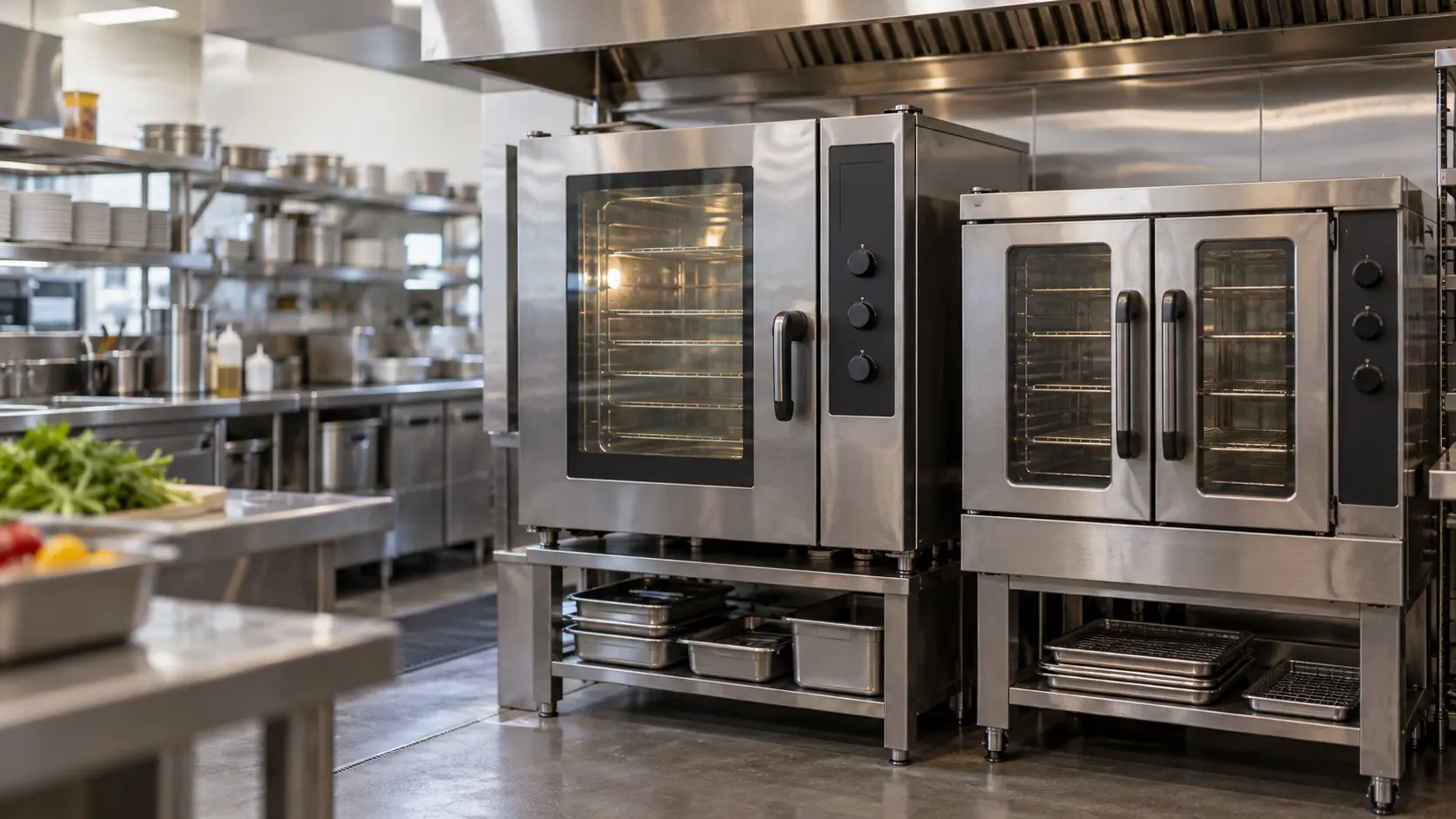
A convection oven blows heated air around the cabinet, which browns faster and more evenly than still air. Blodgett suggests starting about 50°F below a deck oven recipe and lowering further if edges finish before centers. Humidity comes only from the food, or from a pan of water set on the bottom rack, a trick Blodgett suggests for roasts.
A combi oven adds a steam source and a controller that holds a set humidity. In Rational's iCombi Pro, steam mode runs at 100 percent humidity from 86 to 266°F, combi-steam mixes moist and dry heat from 86 to 572°F, and convection mode reaches 575°F. The oven removes excess moisture when the cabinet runs wetter than the setting.
What controlled steam changes on the menu
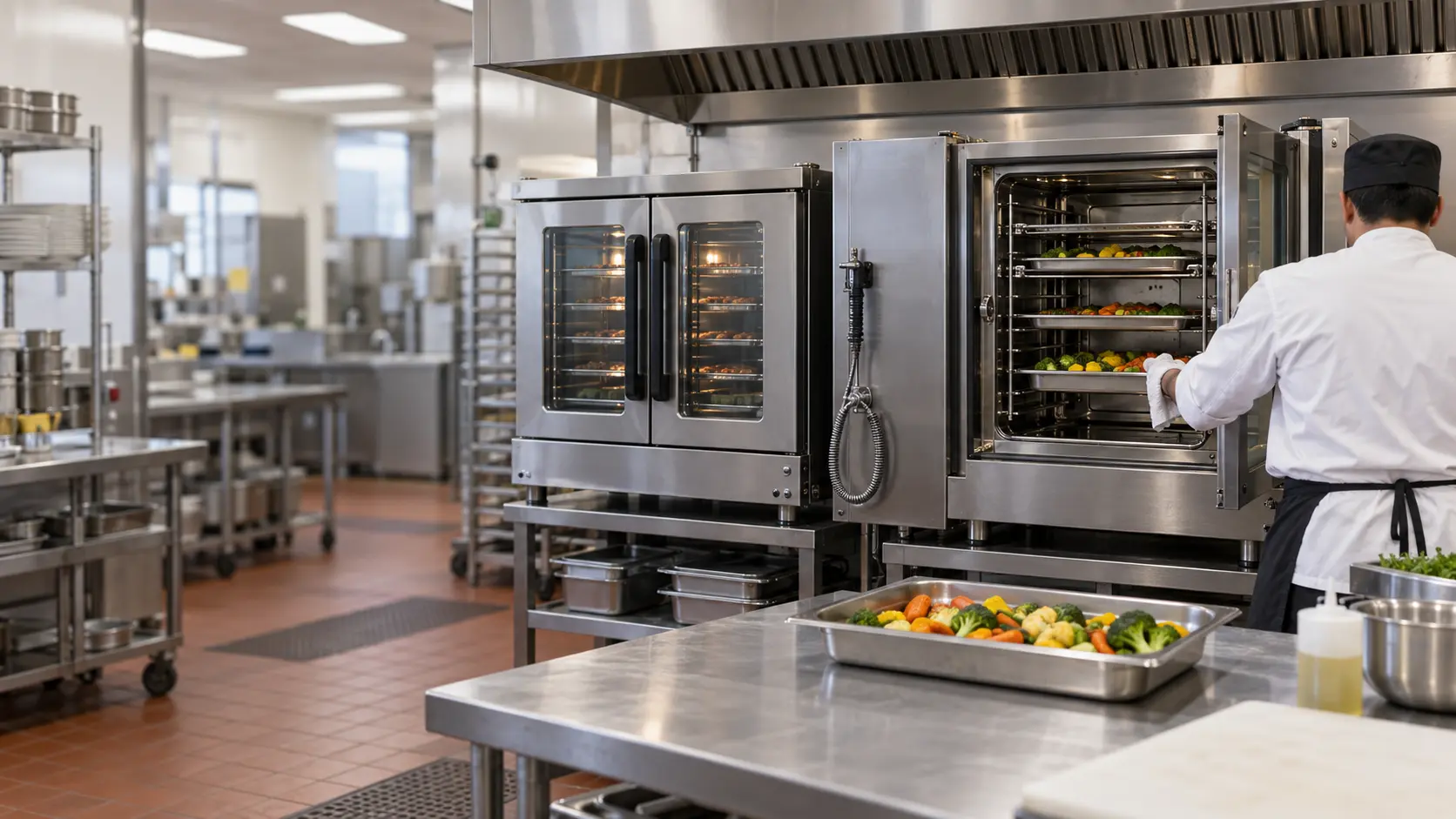
Steam lets one cabinet do the work of a steamer for vegetables, rice and seafood, hold roasts moist at lower temperatures, and rethermalize plated food without drying it. Kitchens that batch-cook proteins, run banquets or feed a hospital tray line lean on those modes every day; a bakery-cafe finishing pastries and cookies may never use them.
Source: Rational — iCombi Pro 20-1/1 and 20-2/1 original instructions for use (US) — Steam mode at 100 percent humidity from 86 to 266°F, combi-steam 86 to 572°F, convection 85 to 575°F; iCareSystem shows cleaning and care status in green, yellow and red and uses only Rational's cleaner and care tabs; service at least once per year.; Blodgett — Zephaire G-ES convection oven installation, operation and maintenance manual — Cook temperatures generally 50°F lower than deck oven recipes; a sheet pan of water adds humidity for roasting; air intakes cleaned weekly; venting checked annually; no lubrication required.
What each oven needs from the building
A gas convection oven needs its gas supply, a circuit for the blower and controls, clearances, and a hood that meets local code. Blodgett also asks that the venting be checked every year for damage from moisture and corrosive flue gases. An electric model trades the gas line for a larger circuit.
A combi needs all of that plus water and a drain. Blodgett's BCX manual calls for 40 to 50 PSI of cold water through a 3/4-inch connection, sets limits on dissolved solids, hardness, chlorides, silica, chlorine and chloramine, and wants an atmospheric vented drain that takes water up to 140°F. Plan the water treatment before the oven arrives, not after the first scale alarm.
- Convection: power or gas, a hood, clearances, a level stand or stacking kit.
- Combi: the same, plus a treated cold water line, a vented floor drain and, on many models, space for cleaning chemicals and a delime jug.
- Both: a data plate that matches the voltage, phase and gas type at the spot.
Source: Blodgett — Zephaire G-ES convection oven installation, operation and maintenance manual — Cook temperatures generally 50°F lower than deck oven recipes; a sheet pan of water adds humidity for roasting; air intakes cleaned weekly; venting checked annually; no lubrication required.; Blodgett — BCX and BX combi oven manual — Water at 40–50 PSI through a 3/4-inch cold connection with hardness 35–180 ppm and chlorides under 25 ppm; atmospheric vented drain, 140°F maximum; delime reminder after 30 hours of boiler operation; cycle about 45 minutes; boilerless BX-14 needs lime removed from the fan and heat source.; lime builds up inside the steam generator, reducing efficiency and damaging the boiler.; ENERGY STAR — Commercial ovens — Certified gas and electric convection ovens are on average about 27 percent more energy efficient; certified combination ovens also meet water consumption limits.

Upkeep compared week by week
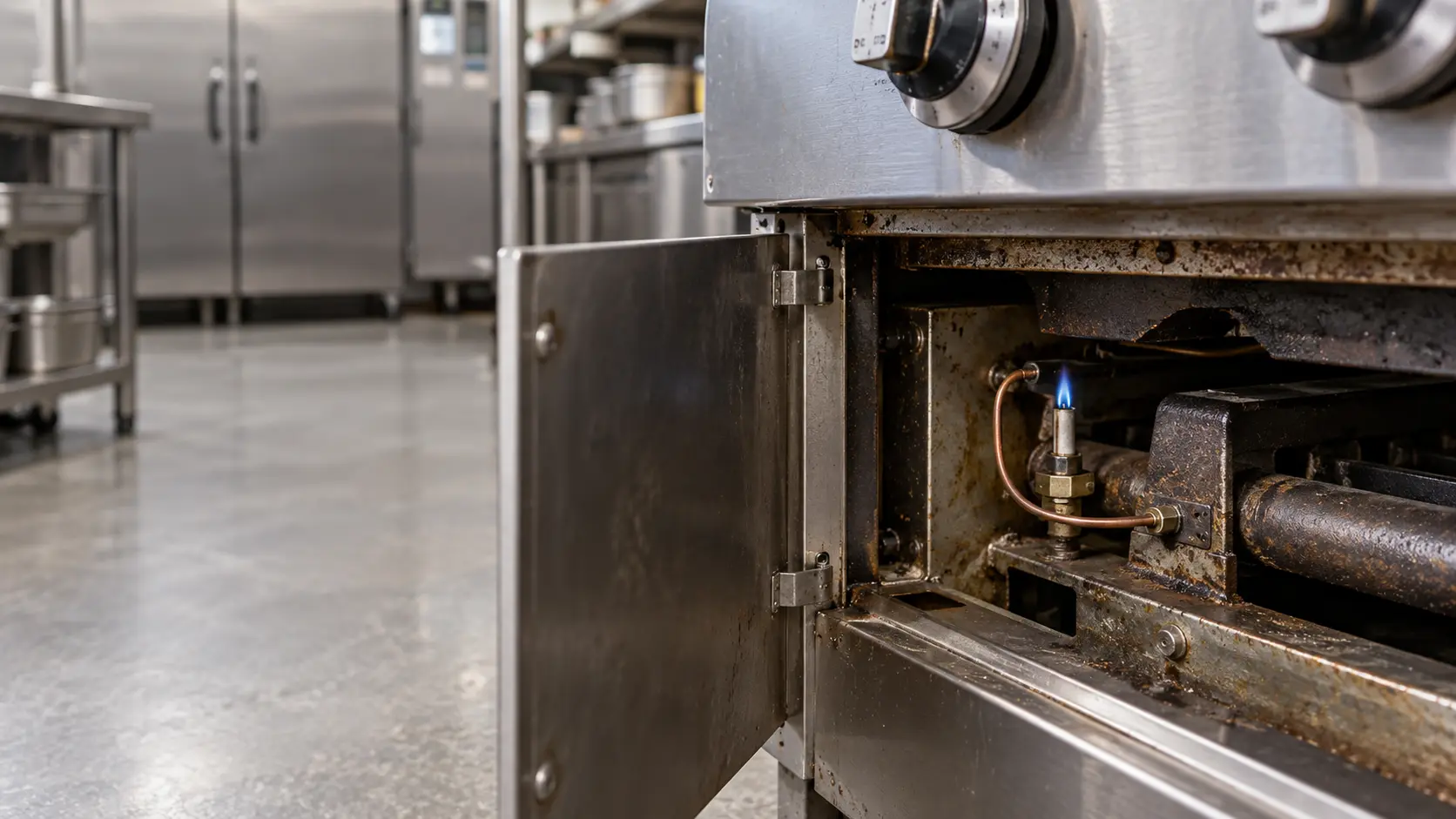
Convection ovens ask for daily wiping, a soak for racks and the blower wheel when needed, and weekly cleaning of the air intakes; Blodgett names the blower motor, the rear cooling fan and the fan guard as the intakes that cool the controls. Beyond the yearly venting check, its manual lists no lubrication.
Combis add a cleaning cycle and scale control. Rational's iCareSystem reads how dirty the cabinet is and how much scale sits in the steam generator, shows each as green, yellow or red, and runs with Rational's own cleaner and care tabs only. Alto-Shaam calls for the CT PROformance to be descaled monthly, and Rational asks for its iCombi Pro to be serviced at least once a year.
Boiler or boilerless combi
Some combis make steam in a separate generator; others spray water onto the fan and heating source. Blodgett's BCX with a steam generator reminds the crew to delime after 30 hours of boiler operation and runs the cycle automatically in about 45 minutes. Its boilerless BX-14 has no generator, but lime still builds on the fan and heat source and is sprayed off by hand, so neither design escapes hard water.
Source: Rational — iCombi Pro 20-1/1 and 20-2/1 original instructions for use (US) — Steam mode at 100 percent humidity from 86 to 266°F, combi-steam 86 to 572°F, convection 85 to 575°F; iCareSystem shows cleaning and care status in green, yellow and red and uses only Rational's cleaner and care tabs; service at least once per year.; Blodgett — Zephaire G-ES convection oven installation, operation and maintenance manual — Cook temperatures generally 50°F lower than deck oven recipes; a sheet pan of water adds humidity for roasting; air intakes cleaned weekly; venting checked annually; no lubrication required.; Alto-Shaam — Combitherm CT PROformance operator's manual (MN-35948), archived copy — On a monthly basis, decalcify or descale the oven; fats and solids coagulate in the drain and back water up into the oven; use the maker's own cleaner only.
What each design tends to need repaired
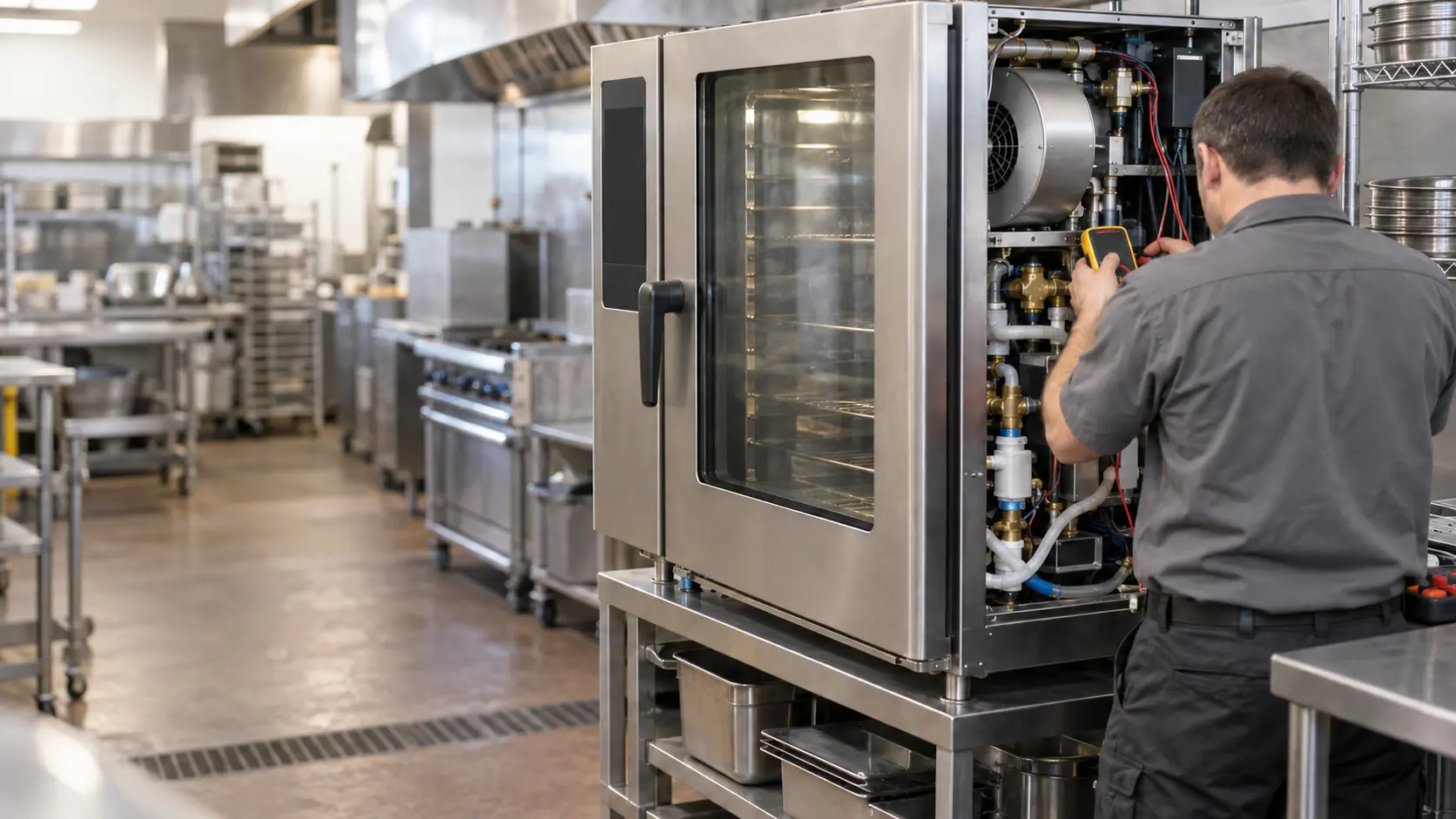
A convection oven's service list is short: blower motors and their bearings, door switches and hinges, igniters and gas valves on gas models, elements on electric ones, and thermostats or controls. A combi carries all of those plus parts that live in water, such as fill solenoids, level probes, the steam generator and its heating elements, drain pumps and valves, and the cleaning pump.
That longer list is not a reason to avoid a combi; it is a reason to budget for water treatment and a yearly visit from the start. The makers' manuals keep returning to three risks: lime in the steam side, fats and solids clogging the drain until water backs up into the cabinet, and cleaning products the maker never approved.
- Shared by both: blower motors, door switches and hinges, thermostats and controls, igniters and gas valves or heating elements.
- Combi only: fill solenoids, water level probes, the steam generator and its elements, drain pumps and valves, the cleaning pump and the hand shower.
Source: Blodgett — BCX and BX combi oven manual — Water at 40–50 PSI through a 3/4-inch cold connection with hardness 35–180 ppm and chlorides under 25 ppm; atmospheric vented drain, 140°F maximum; delime reminder after 30 hours of boiler operation; cycle about 45 minutes; boilerless BX-14 needs lime removed from the fan and heat source.; lime builds up inside the steam generator, reducing efficiency and damaging the boiler.; Alto-Shaam — Combitherm CT PROformance operator's manual (MN-35948), archived copy — On a monthly basis, decalcify or descale the oven; fats and solids coagulate in the drain and back water up into the oven; use the maker's own cleaner only.
Matching the oven to the operation
The right answer depends on how much of the menu uses moisture, the space under the hood, and whether the kitchen can keep up a descaling routine.
When a combi earns its place
Banquet and catering kitchens, schools and hospitals, hotels running several outlets, and restaurants replacing a steamer, a convection oven and a holding cabinet with one footprint all get daily use from steam and combi modes.
When a convection oven is enough
Bakeries, pizza-and-sandwich shops that only finish and bake, cafes with a short menu, and kitchens with no floor drain near the line are usually better served by a convection oven. A second convection oven is often a better buy than a combi that would spend most of its life in dry heat.