What a condensing unit needs from the air around it
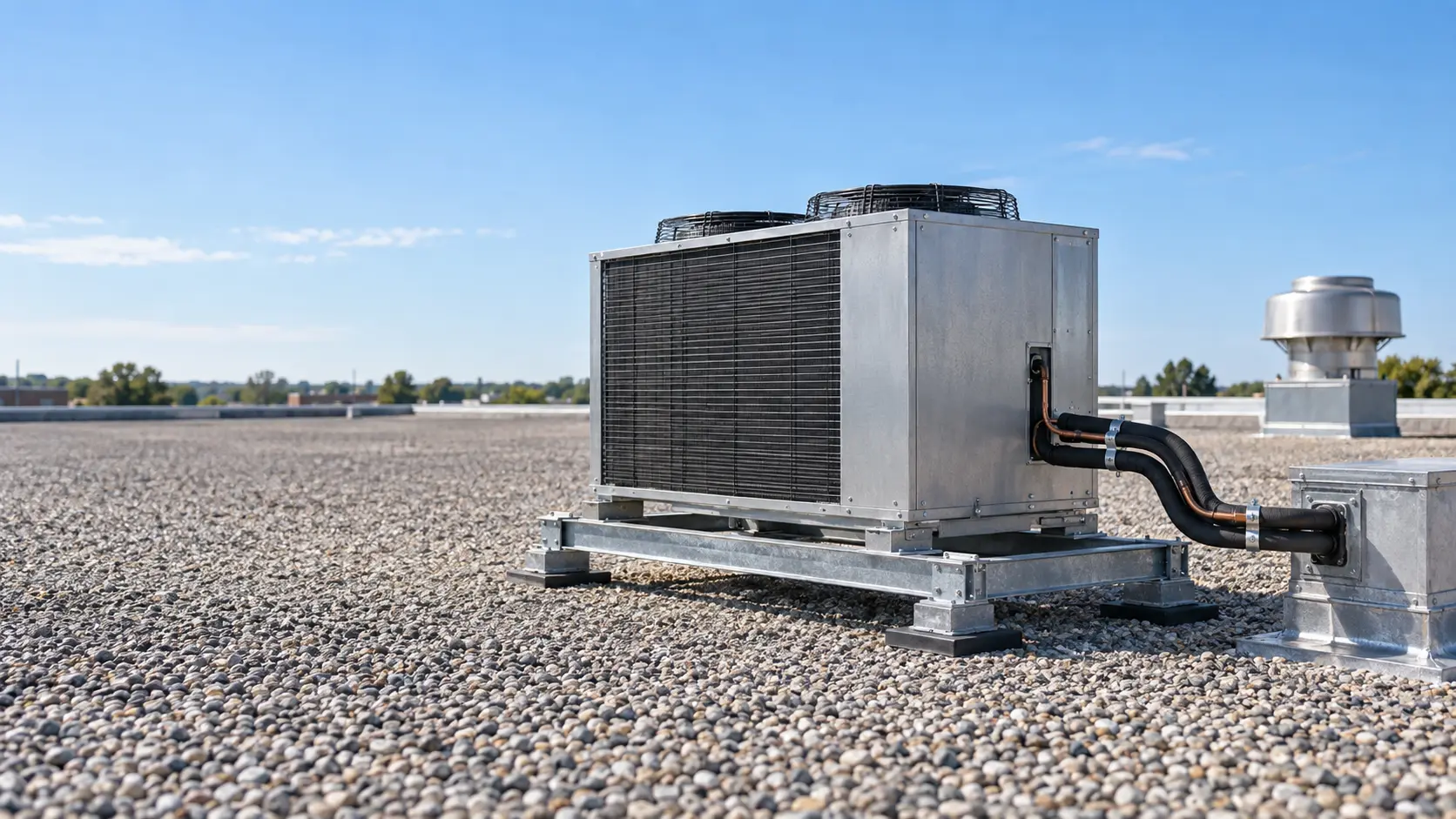
The fans on a condensing unit pull outdoor air across the condenser coil and push it out several degrees hotter. That is how the heat taken out of the walk-in or reach-in leaves the building. Heatcraft's installation manual calls the supply of ambient air and the removal of heated air the most important consideration in placing the unit, and warns that ignoring it brings higher head pressures, poor operation and potential equipment failure.
The penalty lands on the kitchen as a box that holds on a mild morning and drifts in late afternoon, a compressor that barely cycles off, and in the end a compressor worn out years early. Nothing on the controller says the unit is short of air; it simply cannot keep up.
Recirculation: a unit breathing its own exhaust
The worst layout lets the hot discharge loop back into the intake. Heatcraft notes that a unit tucked into a corner formed by two walls may recirculate its own discharge air and lose capacity, and asks for ground-mounted units to have clear space in every direction at least equal to the unit's height. A screen wall, a stack of pallets or a new sign in the wrong place can create that corner long after installation.
Source: Heatcraft — Refrigeration Systems installation and operation manual (H-IM-64L) — Ambient air supply and heated air removal are the key location factors, and failing them raises head pressure; keep units away from steam, hot air and fume exhausts; W clearance on all sides, no overhead obstructions, 2W in pits or three-wall enclosures, largest-unit width side by side and 4 feet end to end, fence rules; corner mounting can recirculate discharge air; roof mounting on steel channels with vibration pads and possibly an engineer's analysis; a 6-inch raised slab on the ground; quarterly checks and semiannual condenser coil cleaning with a non-acid cleaner
The spacing numbers in the maker's manual
Heatcraft expresses its rooftop condensing unit clearance rules in terms of W, the total width of the unit, so they scale from a small single-fan unit to a large multi-fan one. Other makers publish their own figures in the same spirit, and the manual for your unit is the one that counts. These are the ones Heatcraft sets for air-cooled condensing units and remote condensers.
- Walls and obstructions: at least W on every side, more wherever possible
- Overhead: no obstructions at all
- Enclosed by three walls or set in a pit: 2W on the sides, top of the unit level with the top of the pit
- Deeper pits: discharge cones or stacks to carry the hot air up to the top
- Units side by side: at least the width of the largest unit between them
- Units end to end: at least 4 feet apart
- Decorative fences: 50 percent free area, a 1-foot undercut, W of clearance and no taller than the unit
Screen walls and fences around a unit
Landlords and local codes often want rooftop equipment hidden from the street. Heatcraft allows a decorative fence only when it meets every part of the fence rule; if it does not, the unit has to be treated as sitting in a pit, with double the side clearance. Show the fence drawing to the technician before it is built, not after the box starts running warm.
Source: Heatcraft — Refrigeration Systems installation and operation manual (H-IM-64L) — Ambient air supply and heated air removal are the key location factors, and failing them raises head pressure; keep units away from steam, hot air and fume exhausts; W clearance on all sides, no overhead obstructions, 2W in pits or three-wall enclosures, largest-unit width side by side and 4 feet end to end, fence rules; corner mounting can recirculate discharge air; roof mounting on steel channels with vibration pads and possibly an engineer's analysis; a 6-inch raised slab on the ground; quarterly checks and semiannual condenser coil cleaning with a non-acid cleaner

What else lives on a restaurant roof
A kitchen roof is crowded. The hood's exhaust fan throws hot, grease-laden air, the building's own heating and cooling units run their condensers, a dish room may vent steam, and a laundry next door may vent its tumblers. Heatcraft says outright that condensing units must not be located near steam, hot air or fume exhausts, because the unit would be cooling itself with air that is already hot and dirty.
The hood fan is the neighbor that does the most damage. A condensing unit downwind of it draws a mist of grease onto its coil, where it traps dust and cottonwood into a mat that no brush clears easily. When a unit has to share a roof with the exhaust fan, the prevailing wind and the distance between them deserve as much thought as the clearances.
Grease on the fins, and how often the coil is cleaned
Heatcraft's maintenance schedule has the condenser checked quarterly for dirt and debris and the coil and fan blades cleaned twice a year, with a brush, pressurized water and a non-acid foam coil cleaner, rinsed until no residue remains. A unit downwind of a hood fan usually needs the cleaning end of that schedule sooner. It is done with the power off by the technician on a planned visit, not by the crew from a ladder.
Source: Heatcraft — Refrigeration Systems installation and operation manual (H-IM-64L) — Ambient air supply and heated air removal are the key location factors, and failing them raises head pressure; keep units away from steam, hot air and fume exhausts; W clearance on all sides, no overhead obstructions, 2W in pits or three-wall enclosures, largest-unit width side by side and 4 feet end to end, fence rules; corner mounting can recirculate discharge air; roof mounting on steel channels with vibration pads and possibly an engineer's analysis; a 6-inch raised slab on the ground; quarterly checks and semiannual condenser coil cleaning with a non-acid cleaner
Mounting, structure and noise
A condensing unit is heavy and it vibrates. Heatcraft notes that a structural analysis by a qualified engineer may be needed before roof mounting, and that roof units belong level on steel channels or an I-beam frame, with vibration pads or springs between the unit and the frame. It suggests placing them over corridors, restrooms and utility areas rather than over rooms where noise matters, such as a dining room or a hotel's guest floor.
On the ground, Heatcraft suggests a concrete slab raised 6 inches to keep the unit clear of ground water and windblown debris. Either way the unit needs room at the compressor end and on the connection side for service, which a tight enclosure or a new rooftop unit set too close can take away.
Source: Heatcraft — Refrigeration Systems installation and operation manual (H-IM-64L) — Ambient air supply and heated air removal are the key location factors, and failing them raises head pressure; keep units away from steam, hot air and fume exhausts; W clearance on all sides, no overhead obstructions, 2W in pits or three-wall enclosures, largest-unit width side by side and 4 feet end to end, fence rules; corner mounting can recirculate discharge air; roof mounting on steel channels with vibration pads and possibly an engineer's analysis; a 6-inch raised slab on the ground; quarterly checks and semiannual condenser coil cleaning with a non-acid cleaner
What a manager can watch from the ground and the log
Most airflow trouble starts with something that changed rather than something that broke. A contractor sets a new rooftop unit a few feet away, a screen wall goes up, pallets and grease drums get stored against the pad, a tree grows into the discharge. A temperature log that shows the box drifting on hot afternoons and recovering overnight is the pattern to bring to the technician.
Moving a unit, or even turning it, means opening the refrigerant lines, and EPA rules under Section 608 of the Clean Air Act require that work to be done by technicians who hold the matching certification.
Questions to settle before a unit is added or moved
Answer these with the installer on paper before anything is lifted onto the roof.
- Does the new spot give W on every side and nothing overhead?
- How far is it from the hood fan and which way does the wind usually blow?
- Does the roof need an engineer's check for the weight?
- What sits under it inside, and will the noise matter there?
- Can the technician reach the compressor end and the connections?
Source: EPA — Section 608 technician certification — Technicians who maintain, service, repair or dispose of equipment that could release refrigerants must be certified under Section 608