
Air in, air out: why tumblers need both
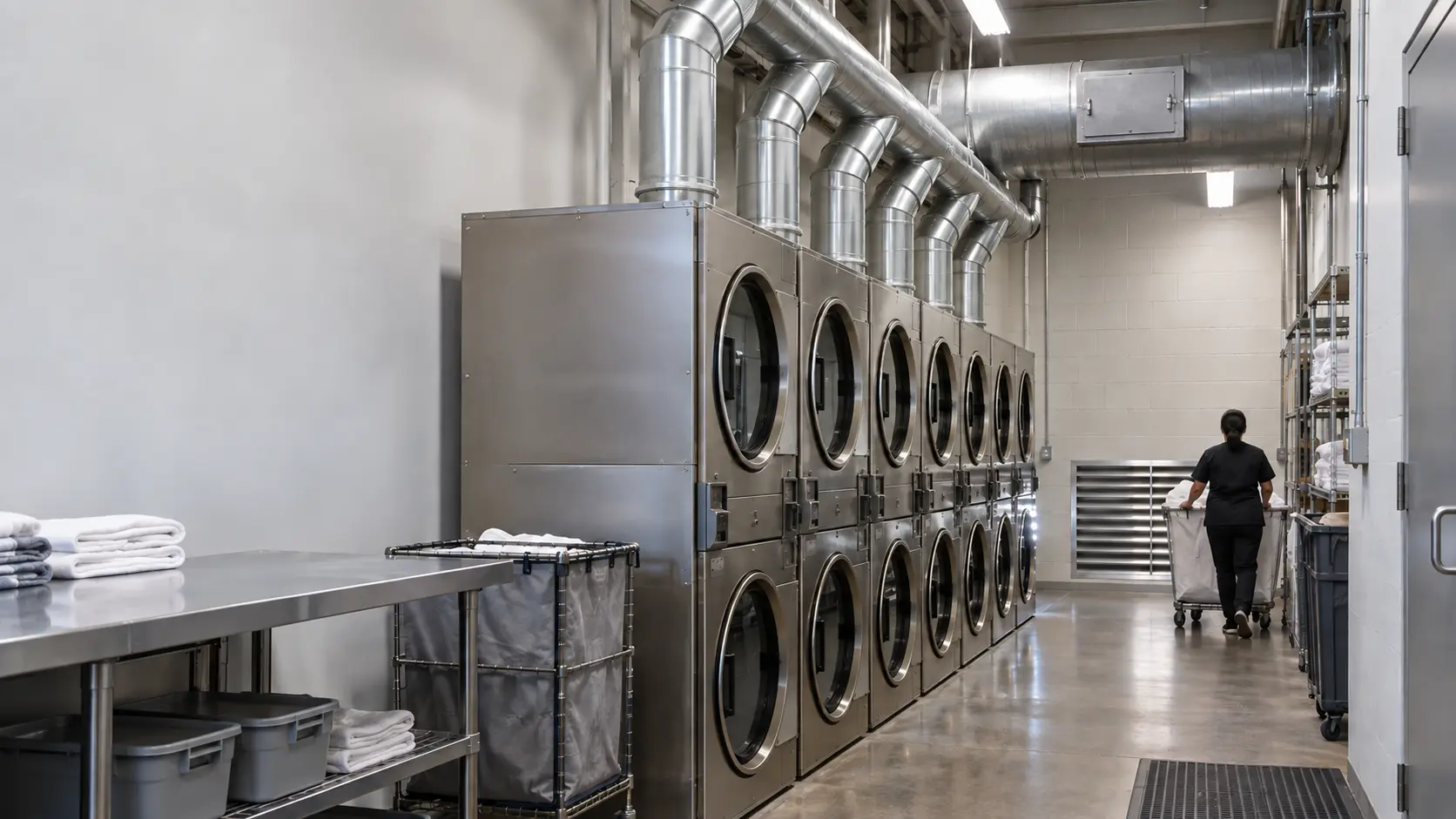
Each machine draws air from the room, heats it, drives it through the tumbling load and throws it outside with the moisture and lint it picked up. Whatever leaves has to be replaced. Dexter's manual for its DDAD50KC stacked models puts the figure at 500 cubic feet per minute for each drum, 1,000 for the pair, and its DTCK80 single-pocket models at 1,200.
Dexter lists what happens when the exhaust is restricted: slow drying, excessive heat and lint in the room. It also explains the less obvious symptom, a high-limit thermostat that keeps cutting the burners off, which makes the machine look like it has a heating problem when the real trouble is the air path.
Makeup air is measured as net free area
The opening Dexter asks for, 1½ square feet per stacked 50-pound machine and 1¼ per 80-pound single, is net effective area. Screens, grilles and louvers block part of an opening, so a louver that looks big enough may deliver far less; Dexter tells installers to ask the grille supplier for its free-area figure. It also wants multiple openings, placed far enough from the machines to give every intake an even share of the air.
Source: Dexter — DDAD50KC Series stacked models operator's and installation manual (8514-141-001) — 500 CFM per drum and 1,000 per machine with 1½ sq ft of net makeup opening; restricted exhaust causes slow drying, excess heat, lint in the room and high-limit cycling; 8-inch duct, 14 feet with two elbows per drum; lapped joints, 1-inch clearance, wall sleeve, damper hood, 24-inch clear outlet, never a screen, cone rain cap, never a chimney; branches at 45 degrees and an inspection door on a main; keep makeup air away from dry cleaners; daily, monthly, semiannual and annual lint tasks; Dexter — DTCK80, DCTD80KC and DCWD80KC Series owner's manual (8514-052-001E) — 1,200 CFM and 1.25 sq ft of net makeup opening per machine; 20 feet of 8-inch duct with two elbows, minus 2 feet per extra elbow, four elbows at most
The exhaust run from collar to outlet
In commercial dryer venting, every foot of pipe and every elbow costs the blower some of its airflow. Dexter's stacked models take an 8-inch round duct, and the manual recommends no more than 14 feet of straight pipe with two right-angle elbows for each drum. Its 80-pound singles allow 20 feet with two elbows, minus 2 feet for each elbow beyond that and no more than four in all. The inside has to be smooth, because, as Dexter puts it, rough surfaces collect lint that eventually clogs the duct.
The outlet end has its own rules. Wind and rain are kept out by a hood with a hinged damper or by turning the pipe end downward, and the outlet stays at least 24 inches from anything that would block the air. A duct through a roof carries the same length limits as one through a wall and needs a cone-type rain cap that will not clog.
- Smooth metal pipe of the diameter on the data plate or in the manual
- Each joint lapped so the upstream section slides inside the next one downstream
- At least 1 inch of clearance between the duct and combustible material
- A metal sleeve wherever the duct passes through a wall
- Never a protective screen over the outlet
- Never vented into a chimney or under the building
Source: Dexter — DDAD50KC Series stacked models operator's and installation manual (8514-141-001) — 500 CFM per drum and 1,000 per machine with 1½ sq ft of net makeup opening; restricted exhaust causes slow drying, excess heat, lint in the room and high-limit cycling; 8-inch duct, 14 feet with two elbows per drum; lapped joints, 1-inch clearance, wall sleeve, damper hood, 24-inch clear outlet, never a screen, cone rain cap, never a chimney; branches at 45 degrees and an inspection door on a main; keep makeup air away from dry cleaners; daily, monthly, semiannual and annual lint tasks; Dexter — DTCK80, DCTD80KC and DCWD80KC Series owner's manual (8514-052-001E) — 1,200 CFM and 1.25 sq ft of net makeup opening per machine; 20 feet of 8-inch duct with two elbows, minus 2 feet per extra elbow, four elbows at most

What the intake air carries in with it
A gas tumbler burns the room's air, so anything in that air goes through the flame. Dexter warns that makeup air and room ventilation for its machines must come from sources away from any dry-cleaning equipment. Solvent vapors break down in the gas flame into products corrosive enough to damage the ducts, the machines and the loads inside them.
The same manuals ask that nothing obstruct the combustion and ventilation air reaching the machines. In a busy store that means keeping cases of detergent, bagged laundry and carts away from the openings, and never covering a makeup air louver to keep out winter drafts.
A laundry that shares a wall with a dry cleaner
Combined stores and strip-mall neighbors are where solvent and flame meet. Where the makeup air openings sit relative to the dry-cleaning machines, the neighbor's vents and the shared rooftop is worth settling with the installer at the design stage, since moving an opening later means new work through the wall or roof.
Source: Dexter — DDAD50KC Series stacked models operator's and installation manual (8514-141-001) — 500 CFM per drum and 1,000 per machine with 1½ sq ft of net makeup opening; restricted exhaust causes slow drying, excess heat, lint in the room and high-limit cycling; 8-inch duct, 14 feet with two elbows per drum; lapped joints, 1-inch clearance, wall sleeve, damper hood, 24-inch clear outlet, never a screen, cone rain cap, never a chimney; branches at 45 degrees and an inspection door on a main; keep makeup air away from dry cleaners; daily, monthly, semiannual and annual lint tasks
The lint schedule that keeps the duct clear
Dexter's preventive maintenance list starts with the lint screen every day, brushed clean and checked for rips. Monthly work goes inside the cabinet, clearing lint from the motor, the controls area and around the burners, which Dexter calls a fire hazard when neglected; that happens with all power disconnected. Once a year the whole duct is inspected and cleaned, from the machine's connection to the exit at the wall or roof.
Drying times are the early warning. When loads start needing an extra cycle, the room runs hotter than it used to or lint gathers around the outlet, the duct and the makeup air belong on the next service visit before anyone looks for a failed heating part.
- Daily: lint screens brushed clean and checked for tears
- Monthly, power off: lint cleared from the motor, controls and burner area
- Every six months: lint cleaned from inside the front panel and the burner air ports
- Yearly: exhaust duct inspected and cleaned to the outlet
Source: Dexter — DDAD50KC Series stacked models operator's and installation manual (8514-141-001) — 500 CFM per drum and 1,000 per machine with 1½ sq ft of net makeup opening; restricted exhaust causes slow drying, excess heat, lint in the room and high-limit cycling; 8-inch duct, 14 feet with two elbows per drum; lapped joints, 1-inch clearance, wall sleeve, damper hood, 24-inch clear outlet, never a screen, cone rain cap, never a chimney; branches at 45 degrees and an inspection door on a main; keep makeup air away from dry cleaners; daily, monthly, semiannual and annual lint tasks