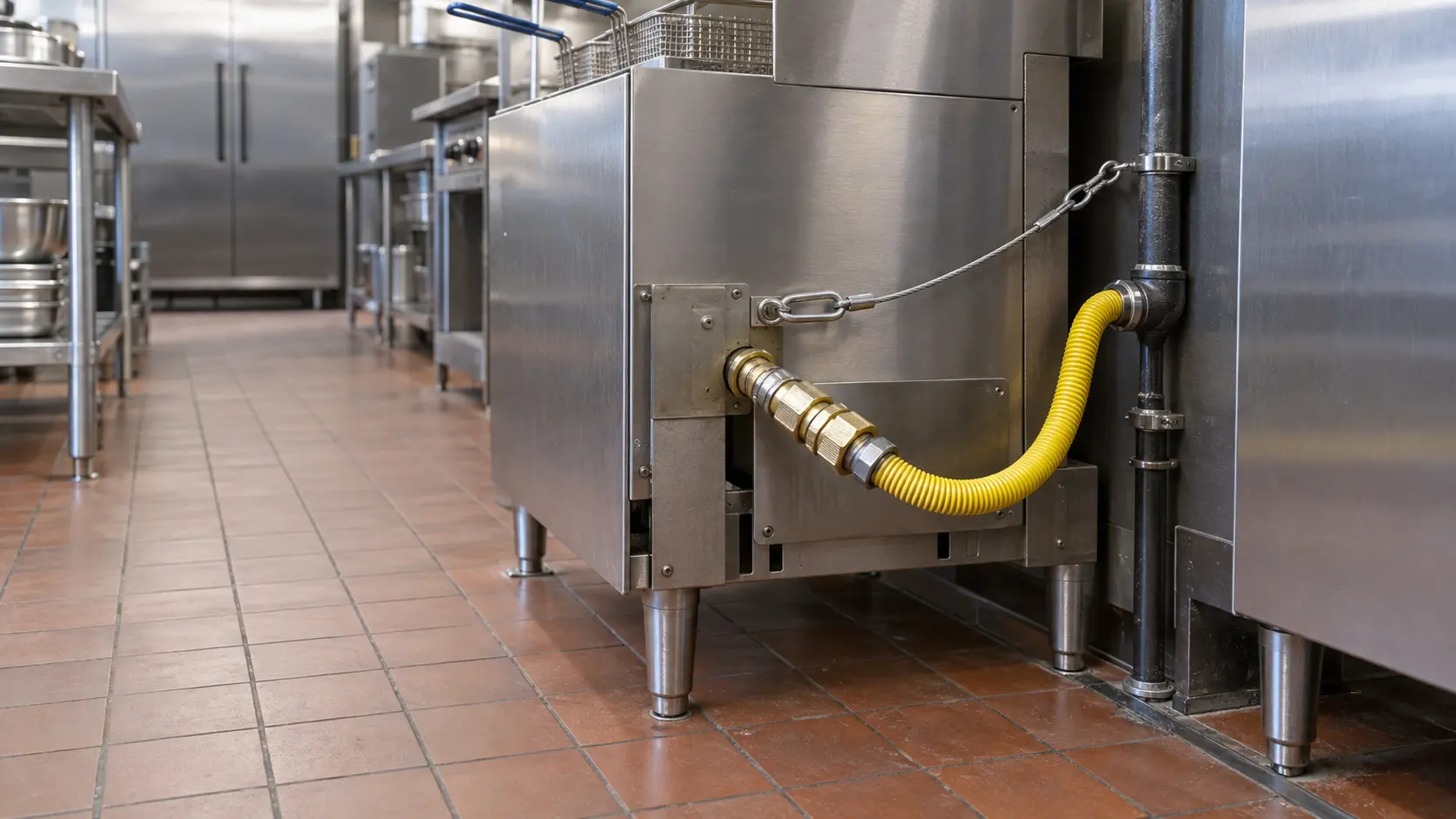

The parts behind a caster-mounted unit
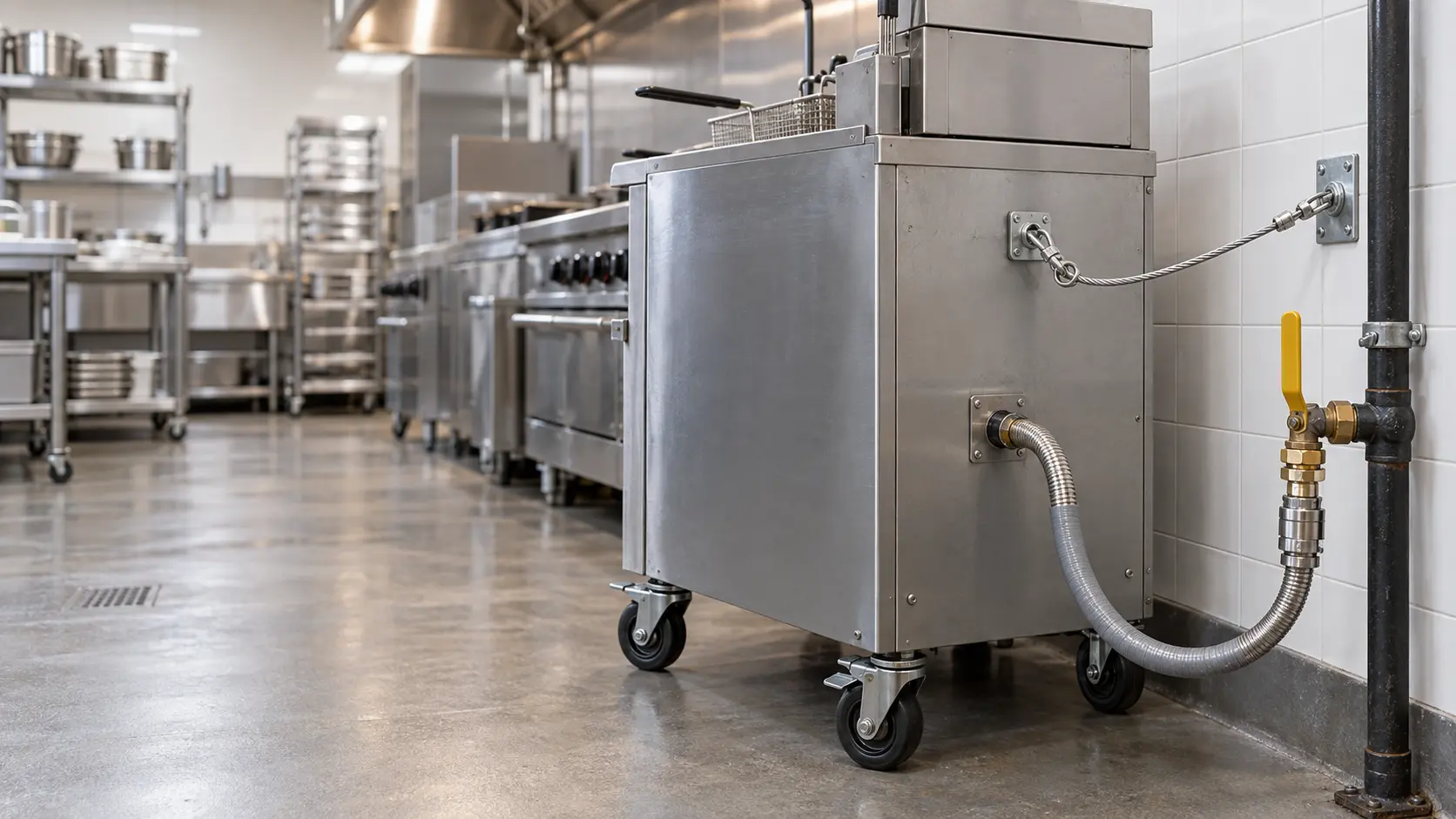
Follow the gas from the wall and you pass five things in a row. The building's pipe or manifold runs behind the line. A manual shutoff valve sits on the drop for each appliance. The flexible connector, usually a coated stainless hose, leaves that valve; its end carries one half of the quick-disconnect coupling, which snaps into the other half. A cable or chain, separate from the hose, ties the back of the appliance to the wall or the pipe support.
The size of all of it matters. Vulcan's fryer manual calls for at least ½-inch iron pipe to a single fryer on a rigid connection but ¾-inch when the optional quick-disconnect hose is used, and 1¼-inch for a battery of fryers. Wolf offers its restaurant ranges with a 4-foot hose and coupling in ¾-inch or 1-inch sizes, and the larger size exists because a big range needs the flow.
- Gas pipe or manifold behind the line
- Manual shutoff valve for the appliance
- Flexible connector listed for movable appliances
- Quick-disconnect coupling at the end of the hose
- Restraint cable or chain anchored to the building
Source: Vulcan — VHG Series gas fryers installation and operation manual (F-47678) — Codes require a gas shutoff valve ahead of the fryer; ½-inch pipe for a single unit, ¾-inch with the quick-disconnect hose, 1¼-inch for batteries; ANSI Z21.69 connector and ANSI Z21.41 quick-disconnect for casters with a restraint at the back panel; fryers restrained against tipping; turn gas off before disconnecting the restraint and reconnect it after returning the fryer; Wolf — Challenger XL Series gas restaurant range installation and operation manual — ¾-inch or 1-inch 4-foot flex hose and quick-disconnect options; Z21.69 connector and Z21.41 quick-disconnect with a restraint at the rear; turn gas off before disconnecting the restraint and reconnect it before turning gas on; relevel a range moved on casters
What the makers write into the installation section
The wording barely changes from one manual to the next. A caster-mounted appliance is installed with a connector that meets ANSI Z21.69 and a quick-disconnect that meets ANSI Z21.41, and some means must limit its movement without relying on the connector, the coupling or its piping to do it. Vulcan says the restraint attaches at a cutout on the back panel; Wolf says at the rear of the range; Garland puts it near the gas inlet and fits brakes to the front casters.
The appliance also has to match the gas it is fed. Frymaster stamps the gas type on the data plate inside the door, says a fryer marked for natural gas goes only on natural gas and one marked for propane only on propane, and warns that switching gas without the proper conversion parts can cause a fire or explosion. Conversions are for qualified installation or service staff.
Why the restraint is shorter than the hose
If a fryer rolls forward, something has to stop it. With no restraint, that something is the hose and its coupling, which were never meant to carry the weight of a loaded fryer. The restraint is set so the appliance reaches the end of the cable while the hose still has slack; Pitco puts a number on it for its Australian installations, a cable no longer than 80 percent of the hose.
Fryers need a second kind of restraint
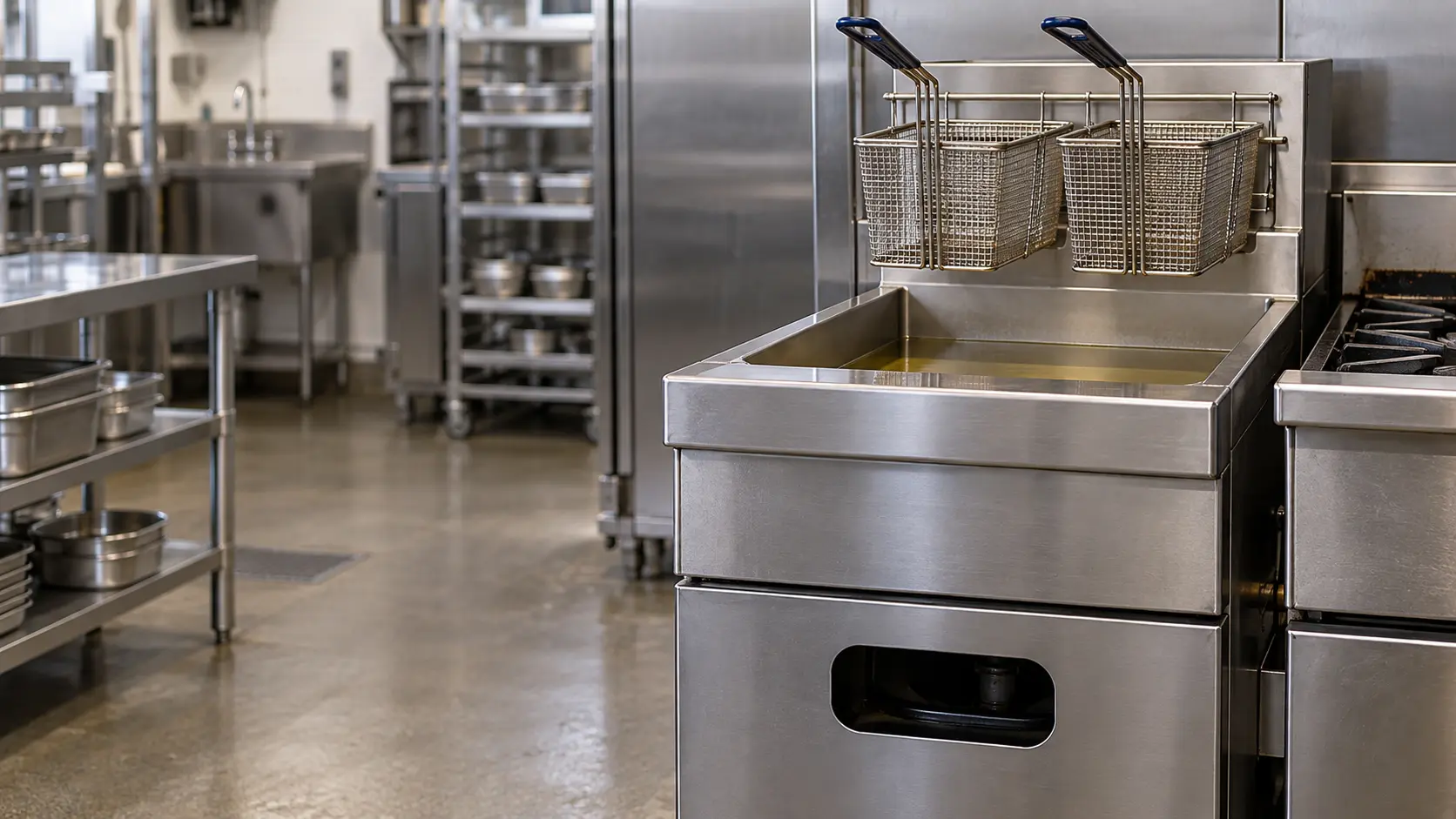
A fryer full of hot oil is also a tipping risk. Vulcan and Pitco require fryers to be restrained against tipping, whether by joining them to a battery of other appliances, setting them in an alcove or tying them to the structure, and Pitco adds that a fryer on a mechanical tie is not operated until someone has checked the tie is in place. Frymaster forbids attaching an apron drainboard to a single fryer because it can make the unit unstable.
Source: Vulcan — VHG Series gas fryers installation and operation manual (F-47678) — Codes require a gas shutoff valve ahead of the fryer; ½-inch pipe for a single unit, ¾-inch with the quick-disconnect hose, 1¼-inch for batteries; ANSI Z21.69 connector and ANSI Z21.41 quick-disconnect for casters with a restraint at the back panel; fryers restrained against tipping; turn gas off before disconnecting the restraint and reconnect it after returning the fryer; Frymaster — OCF FPGL30 gas fryer installation, operation and maintenance manual — Restraining cable connected at all times with a flexible hose; Z21.69 and Z21.41 devices on casters; gas type stamped on the data plate inside the door, NAT only on natural gas and PRO only on propane; wrong-gas operation can cause fire or explosion; no apron drainboard on a single fryer; never use an ignition source to check for leaks; Wolf — Challenger XL Series gas restaurant range installation and operation manual — ¾-inch or 1-inch 4-foot flex hose and quick-disconnect options; Z21.69 connector and Z21.41 quick-disconnect with a restraint at the rear; turn gas off before disconnecting the restraint and reconnect it before turning gas on; relevel a range moved on casters; Garland — Master Series gas convection oven installation, operation and maintenance manual — Z21.69 connector and Z21.41 quick-disconnect with a restraint near the gas inlet; front casters with brakes; reconnect the restraint after the oven is returned to its installed position
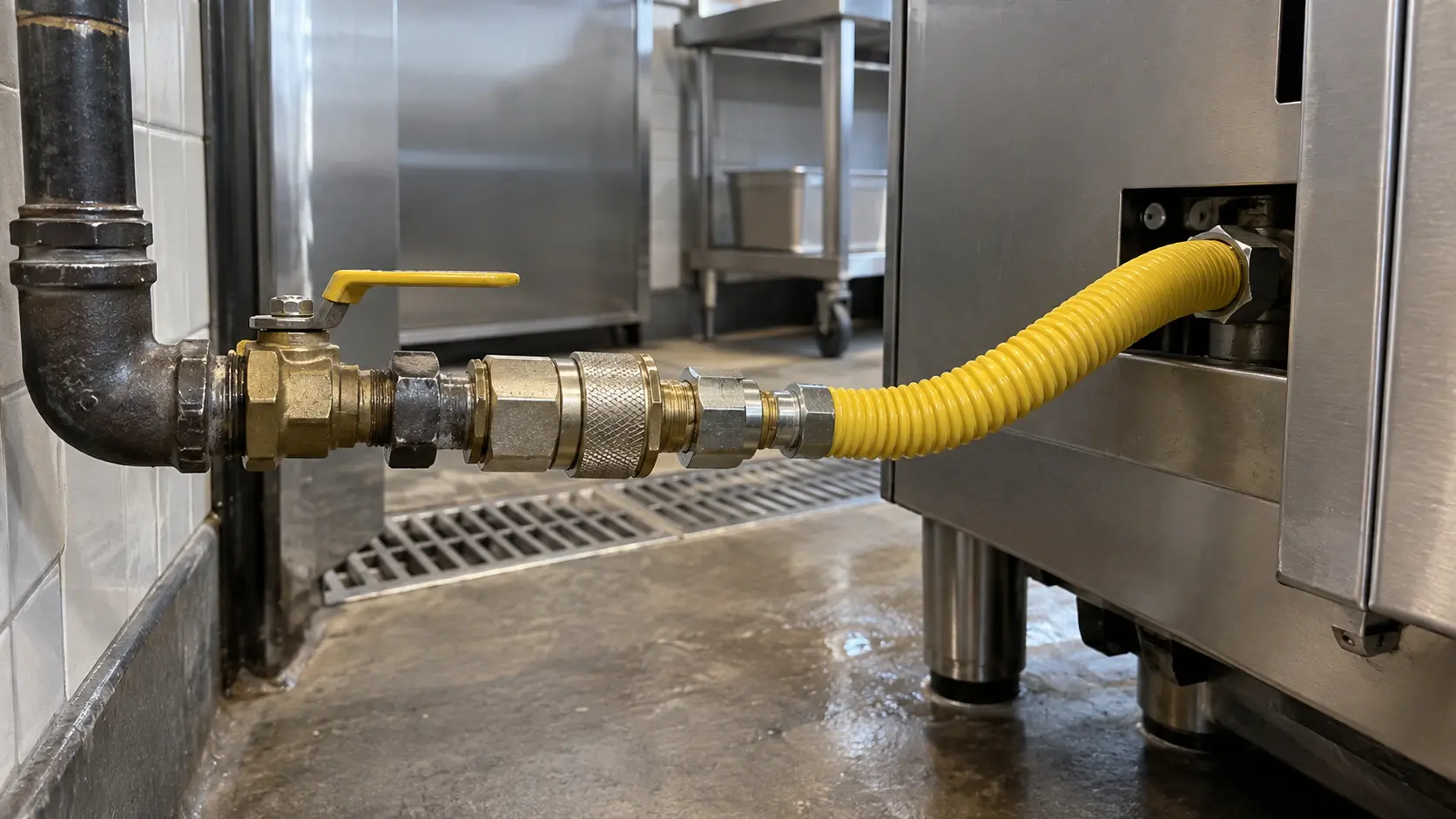
Cleaning night: rolling equipment out and back
The manuals that cover moving a caster-mounted unit agree on one sequence. Vulcan and Wolf say that if the restraint ever has to come off, the gas is turned off first, and the restraint goes back on once the appliance is in its original position, Wolf specifying before the gas is turned back on. Garland says the same for its convection ovens, and Wolf adds that a range moved on casters should be releveled front to back and side to side for even baking.
Whether the closing crew ever separates the coupling itself is a question for the installer at start-up, answered from that appliance's manual. We do not describe uncoupling or recoupling gas here. If the nightly routine seems to require it, ask the installer to show the crew the maker's own procedure, or to set the line up so the hose reach allows cleaning without it.
The fire system above cares where the unit stops
NFPA points out that a hood can be sized perfectly on installation day and still fail its job when equipment is moved for cleaning and not returned to its proper place. The suppression nozzles are aimed at the same footprint. Floor marks or caster stops at each unit's spot make that easy to get right at midnight.
- Restraint clipped back on at every unit
- Hose hanging free, not kinked, twisted or pinned under a caster
- Hose clear of the flue and any hot surface
- Each unit back on its floor marks, under its own nozzle
- Caster brakes set, and no smell of gas anywhere on the line
Source: Vulcan — VHG Series gas fryers installation and operation manual (F-47678) — Codes require a gas shutoff valve ahead of the fryer; ½-inch pipe for a single unit, ¾-inch with the quick-disconnect hose, 1¼-inch for batteries; ANSI Z21.69 connector and ANSI Z21.41 quick-disconnect for casters with a restraint at the back panel; fryers restrained against tipping; turn gas off before disconnecting the restraint and reconnect it after returning the fryer; Wolf — Challenger XL Series gas restaurant range installation and operation manual — ¾-inch or 1-inch 4-foot flex hose and quick-disconnect options; Z21.69 connector and Z21.41 quick-disconnect with a restraint at the rear; turn gas off before disconnecting the restraint and reconnect it before turning gas on; relevel a range moved on casters; Garland — Master Series gas convection oven installation, operation and maintenance manual — Z21.69 connector and Z21.41 quick-disconnect with a restraint near the gas inlet; front casters with brakes; reconnect the restraint after the oven is returned to its installed position
Signs a connector or coupling needs the installer
A hose that has been rolled over, crushed or bent into a tight loop is due for replacement, and so is one whose coating is split, scorched or stiff from heat. A coupling that will not seat, a sleeve that sticks, a restraint cable that has been cut or tied back with wire, and a hose stretched taut when the unit sits in its normal spot all point at the same visit.
Changes to the line count too. Pitco's manual expects the supply to deliver a steady pressure to every appliance at once without losing it at any one of them, so adding a fryer or swapping a griddle for a larger charbroiler can leave the whole manifold short. The same swap can take a unit out of the fire system's coverage, which is why Pitco sends owners to a fire-system professional whenever appliances under an existing system are added or replaced.
What the installer does on start-up day
The manuals put a short list in front of the installer before the first light: confirm the gas type against the data plate, test the supply piping with the appliance disconnected or isolated at its valve as the pressure calls for, check every joint for leaks with a soap solution and never a flame, and verify the supply and manifold pressures. Keep the manual and a note of what was checked with your equipment records.
Source: Pitco — gas fryer installation and operation manual (L20-378) — Australian restraining cable no longer than 80 percent of the hose; fryers restrained from tipping and a mechanical tie checked before operation; the gas line must supply all appliances without losing pressure; adding or replacing appliances under a fire safety system may need modifications; test the supply line before use