
How fryer oil gets from cooking heat to flame
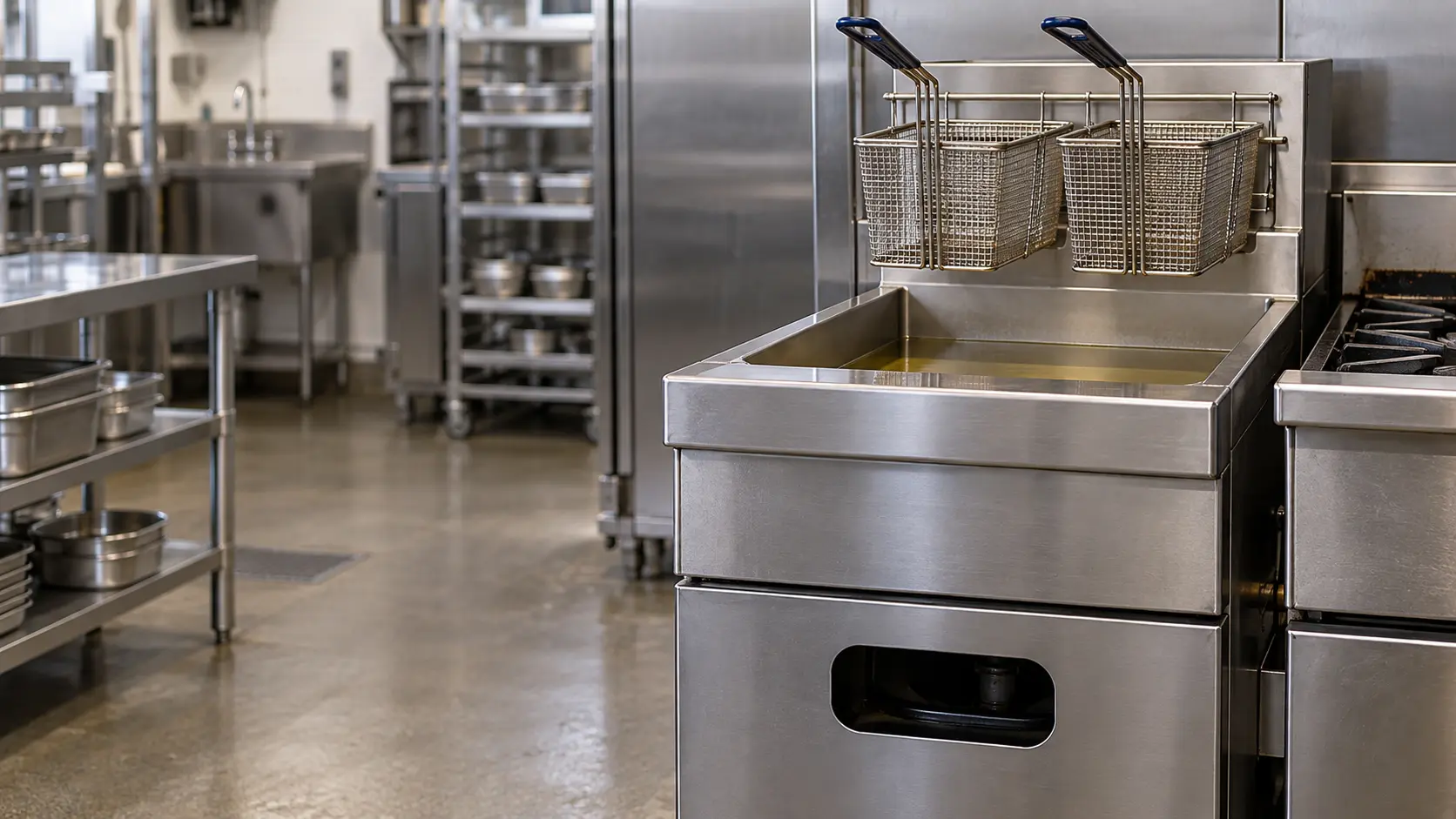
Oil at its frying set point is not burning, and on a healthy fryer it never gets close. Several ordinary habits shrink that margin. Pitco warns that old shortening has a reduced flash point and surges more readily when product drops in, and that the oil level should never fall below the minimum line. NFPA's guidance for restaurant managers asks crews to check the level before starting a fryer, because heating surfaces sitting at or near the oil surface can set residue and oil alight.
Crumbs are the other slow fuel. Frymaster and Pitco both require the crumb tray or filter pan to be emptied into a fireproof container at the end of each day, since some food particles left soaking in certain shortenings can combust on their own overnight.
- Oil topped up to the fill line before the burners or elements come on
- Oil changed on the schedule the filtration log sets, not stretched through a weekend
- Crumb tray and filter pan emptied into a metal, fireproof container at close
- Ice, water and staff drinks kept away from the vats, as OSHA's restaurant eTool advises
The high-limit is a guard, not a reset button
Behind the thermostat sits a separate high-limit control that shuts off the heat if the oil runs away. Frymaster's test mode expects its high-limit to open somewhere between 423°F and 447°F on North American models, and says to disconnect power and call for service if the controller shows a high-limit failure. Vulcan's gas fryers reset their over-temperature shutoff automatically once the oil cools, but the manual says not to power up again until the oil is below 300°F and to call service if it keeps happening.
Source: NFPA — 8 tips for restaurant facility managers — Check fryer oil level before starting because exposed heating surfaces can ignite residue and oil; dry-chemical systems no longer pass UL 300; fuel and power to protected equipment shut off automatically; the pull-aim-squeeze-sweep method; failure to clean was a factor in 1 in 5 restaurant fires; OSHA — Young Worker Safety in Restaurants eTool: Cooking — Sound an alarm, summon the fire department and activate the fixed suppression system first; the manual pull station is usually near an exit; use a Class K extinguisher on grease fires; never throw water on a grease fire; never move hot or burning oil; keep drinks, water and ice away from fryers; Pitco — gas fryer installation and operation manual (L20-378) — Old shortening has a reduced flash point and surges more; keep oil above the minimum line; empty the crumb catch into a fireproof container daily; adding or replacing appliances under an existing fire safety system may require modifications by a qualified professional; Frymaster — OCF FPGL30 gas fryer installation, operation and maintenance manual — Empty the crumb tray into a fireproof container daily; the high-limit test expects a trip at 423°F to 447°F on non-CE models; on a high-limit failure disconnect power and call for service
What the hood suppression system does when it trips
The hood fire suppression system over a fry station is a set of nozzles aimed at each appliance and into the hood plenum and duct, fed by a tank of wet chemical. NFPA explains that commercial cooking systems must be listed to UL 300, which only wet-chemical systems now pass, because the test moved to vegetable oil in the early 1990s and older dry-chemical designs no longer put that fire out. The agent separates the burning oil from the air long enough for the vat to cool.
It trips on its own when fusible links in the exhaust airflow melt, and a manual release lets a cook fire it by hand. When it discharges, the gas and electric power feeding the protected equipment must shut off automatically so the fire cannot relight. The small caps on each nozzle keep grease out and are meant to blow off in a discharge, so a missing cap belongs on the next service call.
Swapping or adding equipment under the hood
Each system is laid out for the appliances that were under it when it was designed. NFPA warns that replacing or rearranging equipment without reviewing the system can leave a fire it cannot put out, and Pitco tells owners to have a fire-system professional confirm coverage whenever appliances are added or replaced beneath an existing system. Rolling a fryer back to a slightly different spot after cleaning moves it out from under its nozzle, too.
Source: NFPA — Restaurant fire protection basics — Kitchen systems must be UL 300 listed wet chemical, trip by fusible links or a manual release, and nozzle caps blow off on discharge; changing equipment without review can defeat the system; a placard at each Class K extinguisher says to activate the system first; staff instruction at hiring and annually; systems maintained every 6 months with fusible links replaced; hoods inspected for grease, typically semiannually; NFPA — 8 tips for restaurant facility managers — Check fryer oil level before starting because exposed heating surfaces can ignite residue and oil; dry-chemical systems no longer pass UL 300; fuel and power to protected equipment shut off automatically; the pull-aim-squeeze-sweep method; failure to clean was a factor in 1 in 5 restaurant fires

The order the crew follows during a fryer fire
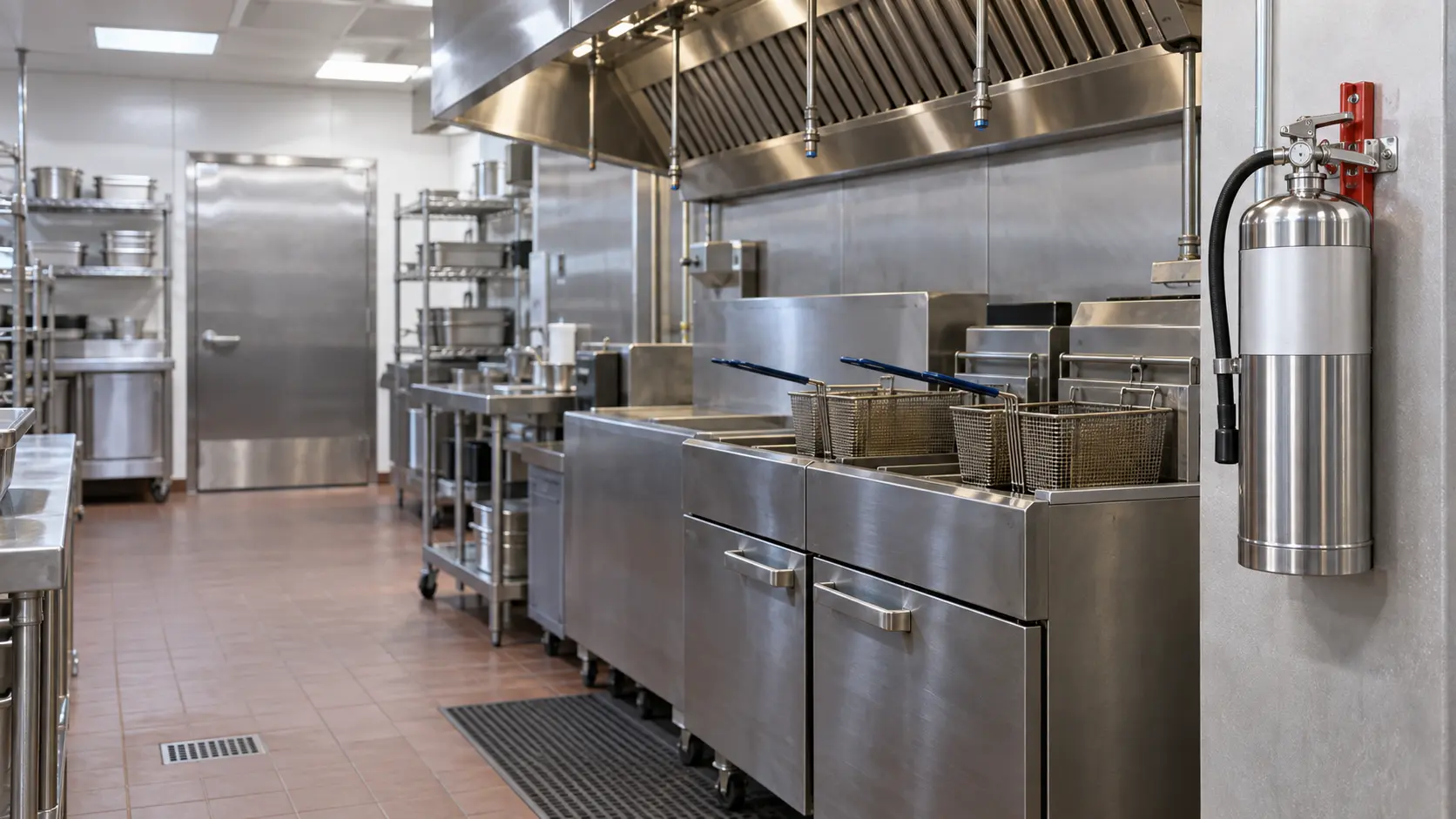
OSHA's guidance for restaurant workers puts it plainly: sound the alarm, summon the fire department and activate the fixed suppression system first. The manual pull station usually sits on the wall near an exit, and the instructions for firing it are printed on the station itself. Only after that does anyone pick up the Class K extinguisher, which is the backup rather than the main tool; NFPA requires a placard beside each one saying exactly that.
With the extinguisher, NFPA's short method is to pull the pin, aim low at the base of the fire, squeeze the handle and sweep from side to side. If the fire has left the vat, climbed into the duct or keeps growing after the system and one extinguisher, the crew leaves and lets the fire department take it.
Why water turns a vat fire into a room fire
Water is heavier than oil, sinks under the burning surface and flashes to steam at once, throwing flaming oil out of the vat and across the line. OSHA's eTool says never to throw water on a grease fire and never to carry or move an oil container while the oil is hot or burning. A wet towel, a pot of ice or a sheet pan of water are the same mistake in smaller doses.
Source: NFPA — Restaurant fire protection basics — Kitchen systems must be UL 300 listed wet chemical, trip by fusible links or a manual release, and nozzle caps blow off on discharge; changing equipment without review can defeat the system; a placard at each Class K extinguisher says to activate the system first; staff instruction at hiring and annually; systems maintained every 6 months with fusible links replaced; hoods inspected for grease, typically semiannually; NFPA — 8 tips for restaurant facility managers — Check fryer oil level before starting because exposed heating surfaces can ignite residue and oil; dry-chemical systems no longer pass UL 300; fuel and power to protected equipment shut off automatically; the pull-aim-squeeze-sweep method; failure to clean was a factor in 1 in 5 restaurant fires; OSHA — Young Worker Safety in Restaurants eTool: Cooking — Sound an alarm, summon the fire department and activate the fixed suppression system first; the manual pull station is usually near an exit; use a Class K extinguisher on grease fires; never throw water on a grease fire; never move hot or burning oil; keep drinks, water and ice away from fryers
Inspections that keep the hood and extinguishers ready
NFPA's summary of NFPA 96 sets the rhythm: the extinguishing system serviced at least every 6 months with every pull station, detector and actuator tested, metal-alloy fusible links replaced on that same cycle, and the exhaust system inspected for grease on a schedule that is semiannual for most restaurants and tighter for high-volume or solid-fuel cooking. When an inspection finds grease deposits, the hood and duct are cleaned. NFPA's research found a failure to clean among the factors in about 1 in 5 restaurant fires.
OSHA adds the portable side. Under 29 CFR 1910.157, extinguishers get a visual check every month and a recorded maintenance check every year, and employees expected to use them are taught how on assignment and at least yearly after that.
- Monthly: a manager checks each extinguisher's gauge, pin and seal, and initials the tag
- Every 6 months: the fire-protection contractor services the hood system and replaces links
- On the inspection schedule: the hood and duct are checked for grease and cleaned when needed
- Yearly: the extinguisher maintenance check is recorded and the crew is walked through the pull station again
- Every shift: nozzles clear, caps on, and nothing stacked in front of the pull station
Source: NFPA — Restaurant fire protection basics — Kitchen systems must be UL 300 listed wet chemical, trip by fusible links or a manual release, and nozzle caps blow off on discharge; changing equipment without review can defeat the system; a placard at each Class K extinguisher says to activate the system first; staff instruction at hiring and annually; systems maintained every 6 months with fusible links replaced; hoods inspected for grease, typically semiannually; NFPA — 8 tips for restaurant facility managers — Check fryer oil level before starting because exposed heating surfaces can ignite residue and oil; dry-chemical systems no longer pass UL 300; fuel and power to protected equipment shut off automatically; the pull-aim-squeeze-sweep method; failure to clean was a factor in 1 in 5 restaurant fires; OSHA — 29 CFR 1910.157, portable fire extinguishers — Monthly visual inspection, a recorded annual maintenance check, and training for designated employees on assignment and at least annually
After a discharge: cleanup, service and the first heat
A tripped system has done its job and is now empty. The fire-protection contractor recharges it, replaces the links and resets the gas and power shutoff; until then the line under that hood has no protection and stays cold.
A fire in the kitchen also touches the permit. The FDA Food Code tells a permit holder to stop operations and notify the regulatory authority when a fire may create an imminent health hazard, and to get the authority's approval before reopening, so food exposed to smoke or agent is held for the inspector's decision.
What the fryer needs before the vat heats again
A fire usually has a cause inside the fryer. The technician checks the temperature probe, the thermostat or controller and the gas valve or contactors, and runs the high-limit through its test so the kitchen knows the last guard actually trips. Fresh oil goes in only after the vat has been cleaned of agent and passes that test.
Source: FDA — Food Code 2022 — Discontinue operations and notify the regulatory authority when a fire may cause an imminent health hazard (8-404.11); obtain approval before resuming (8-404.12)