

Strainers and wash arms: the first things to open
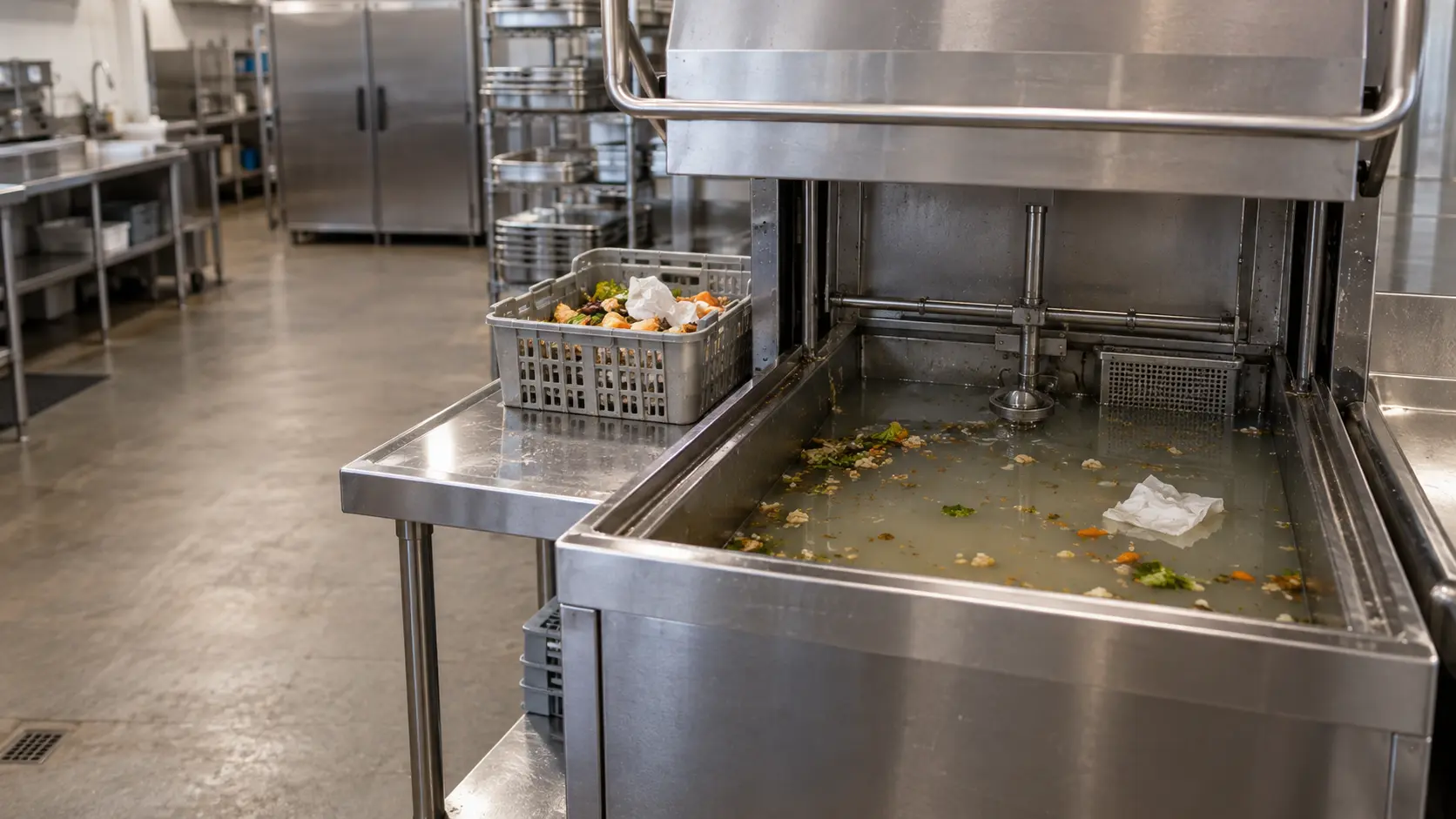
Hobart's troubleshooting table for its LXn undercounter dish machines starts where most service visits end: strainers so clogged the pump cannot draw enough water, wash arms obstructed, and arms that no longer turn. A strainer basket packed with lemon seeds, napkin shreds and rice starves the pump, and the water that does reach the arms leaves through half of the nozzles.
Hobart asks for a thorough cleaning at the end of every shift or at least daily, with the arms taken off and flushed. When they go back on, spin each one by hand; it should turn freely and coast to a stop. A missing end cap, a cracked arm, or one that was never seated properly will wash one side of the rack and skip the other.
End-of-shift checklist for the dish room
- Drain the machine, then lift out the strainer pan and basket
- Rinse the strainers in the sink instead of banging them on a rack
- Remove the wash and rinse arms and flush every nozzle
- Wipe the interior with a soft cloth, never steel wool on stainless
- Refit the arms and make sure the strainer basket is locked
Source: Hobart — LXn / LXGn Series instructions manual (F41243) — Dishes not clean: clogged strainers, obstructed or stuck arms, soil, rack loading, low water, wash under 120°F chemical or 150°F hot-water; clean every shift or at least daily; detergent-empty message after 3 cycles; 50 to 100 ppm chlorine; hardness 3 grains per gallon or less; delime interval set from hardness
Heat in the wash tank and the final rinse
Wash water that is too cool will not lift fats and starches. The Food Code sets minimum wash temperatures for machines that sanitize with hot water: 165°F for a stationary rack single-temperature machine, 150°F for a stationary rack dual-temperature machine, 160°F for a single-tank conveyor and 150°F for a multitank conveyor. Machines that sanitize with chemicals need at least 120°F. Hobart's LXn manual looks for a wash above 150°F on its hot-water models and above 120°F on its chemical ones.
On a hot-water machine the final rinse does the sanitizing, and the Food Code wants it no cooler than 180°F where it enters the manifold, 165°F on a stationary rack single-temperature machine, and no hotter than 194°F. Most machines get there through a booster heater. Watch the display through a full cycle: a rinse that never reaches its figure, or a wash that sags during a rush, points at the booster, a heating element or incoming water that arrives too cool.
Checking what the plates actually reach
The Food Code also expects utensil surfaces in a hot-water machine to reach 160°F, measured with an irreversible registering temperature indicator such as a heat-sensitive label or a maximum-registering thermometer sent through on a rack. Keep a supply in the office. An indicator that comes out unchanged is a far stronger reason to book than a hunch.
Source: FDA — Food Code 2022 — Wash solution minimums of 165°F, 150°F, 160°F and 150°F by machine type and 120°F for chemical machines (4-501.110); final rinse at the manifold 180°F, 165°F on stationary rack single-temperature machines, no more than 194°F (4-501.112); utensil surface 160°F (4-703.11); sanitizer concentration measured with a test kit (4-501.116); Hobart — LXn / LXGn Series instructions manual (F41243) — Dishes not clean: clogged strainers, obstructed or stuck arms, soil, rack loading, low water, wash under 120°F chemical or 150°F hot-water; clean every shift or at least daily; detergent-empty message after 3 cycles; 50 to 100 ppm chlorine; hardness 3 grains per gallon or less; delime interval set from hardness

Detergent, rinse aid, sanitizer and hard water
An empty drum or a kinked pickup tube turns a dish machine into an expensive hot rinse. Hobart lists low chemicals, an air leak at the feed-hose fittings and kinked tubes as the reasons chemicals stop feeding, and the LXn shows a detergent-empty message once three cycles have run with no supply. Check that each pickup tube reaches the bottom of the correct container and that every line runs in smooth bends.
Chemical sanitizing machines need their concentration tested, and the Food Code requires a test kit or other device for it; Hobart's figure for its chlorine models is 50 to 100 parts per million on the glass surface. Spots and film, on the other hand, are often the water. Hobart recommends 3 grains of hardness per gallon or less, says anything harder needs treatment, and names hard water and the wrong detergent strength among the causes of spotting.
Film, spots or stains: what each one suggests
- Gray film on glassware: hardness, low rinse aid or detergent at the wrong strength
- Brown stains: iron in the supply, which Hobart says may call for an iron filter
- Black or gray marks: ware rubbed against aluminum
- Food left in the same place on every plate: a blocked nozzle or the way the rack was loaded
Source: FDA — Food Code 2022 — Wash solution minimums of 165°F, 150°F, 160°F and 150°F by machine type and 120°F for chemical machines (4-501.110); final rinse at the manifold 180°F, 165°F on stationary rack single-temperature machines, no more than 194°F (4-501.112); utensil surface 160°F (4-703.11); sanitizer concentration measured with a test kit (4-501.116); Hobart — LXn / LXGn Series instructions manual (F41243) — Dishes not clean: clogged strainers, obstructed or stuck arms, soil, rack loading, low water, wash under 120°F chemical or 150°F hot-water; clean every shift or at least daily; detergent-empty message after 3 cycles; 50 to 100 ppm chlorine; hardness 3 grains per gallon or less; delime interval set from hardness
Scraping, racking and what the crew controls
Hobart names two causes no technician can fix: soil left on the ware and poor rack loading. Plates stacked touching, bowls nested, cups facing up and sheet pans leaned across the rack all hide surfaces from the spray. Scrape into the bin, pre-rinse where the dish room has a sprayer, and use the right rack for each item, with flatware standing in cylinders rather than lying across a peg rack.
If the machine washed well last month and the dish crew has changed since, watch a full shift before booking. A machine that looks broken from the office is often a rushed closer skipping the strainers and packing racks to the edge.
Source: Hobart — LXn / LXGn Series instructions manual (F41243) — Dishes not clean: clogged strainers, obstructed or stuck arms, soil, rack loading, low water, wash under 120°F chemical or 150°F hot-water; clean every shift or at least daily; detergent-empty message after 3 cycles; 50 to 100 ppm chlorine; hardness 3 grains per gallon or less; delime interval set from hardness
When the problem really is inside the machine
With strainers, arms, heat, chemicals and loading ruled out, what remains is mechanical: a wash pump with a worn seal or impeller, a fill valve that stops short, a booster element crusted in scale, a sensor reading wrong, or a drain that lets wash water escape mid-cycle. Hobart's table ends on the same note, saying that if symptoms persist after the possible causes are checked, service may be required.
Scale deserves its own mention. Hobart's automatic delime models set their delime interval from the water hardness entered at installation, and the manual models rely on the chemical supplier's schedule. White crust on the arms, the heater or the chamber walls means deliming is overdue and heat is already being lost.
Source: Hobart — LXn / LXGn Series instructions manual (F41243) — Dishes not clean: clogged strainers, obstructed or stuck arms, soil, rack loading, low water, wash under 120°F chemical or 150°F hot-water; clean every shift or at least daily; detergent-empty message after 3 cycles; 50 to 100 ppm chlorine; hardness 3 grains per gallon or less; delime interval set from hardness