What are the two stages of cooling, and what is the time limit?
Under the FDA Food Code, cooked food that needs time and temperature control for safety must cool from 135°F to 70°F within 2 hours, and from 135°F to 41°F or below within 6 hours in total (section 3-501.14). The clock runs from 135°F, so a batch that reaches 70°F in 1 hour has 5 hours left for the second stage, and one that takes the full 2 hours has 4.
Why the first stage is the strict one
The Food Code's notes on cooling name 70°F to 125°F as the range nearest ideal for bacterial growth, so the first two hours are the dangerous ones, and the Code treats the 2-hour step as critical even when the 6-hour total is met. FDA inspection guidance in the Code's annex says a batch still above 70°F within the first 2 hours may be reheated to 165°F for 15 seconds and cooled again by a faster method; once it is past 2 hours and still above 70°F, it is discarded. Your health department may set its own rule.
Why the second stage matters too
A pan that drops to 70°F quickly can still stall at 55°F inside a crowded box. The second stage ends only when the center of the food reads 41°F or colder, and that is a probe reading taken in the thickest part of the food, not the temperature the box display shows.
| Stage | From | To | Time allowed |
|---|---|---|---|
| First | 135°F | 70°F | 2 hours |
| Second | 70°F | 41°F or colder | The rest of 6 hours from 135°F |
Local health departments adopt the Code with changes, so check the version your jurisdiction uses and any cooling-log rule it sets.
Source: FDA Food Code 2022 — section 3-501.14 sets the cooling limits of 135°F to 70°F within 2 hours and to 41°F or colder within 6 hours in total
Which cooling methods really reach the limits?
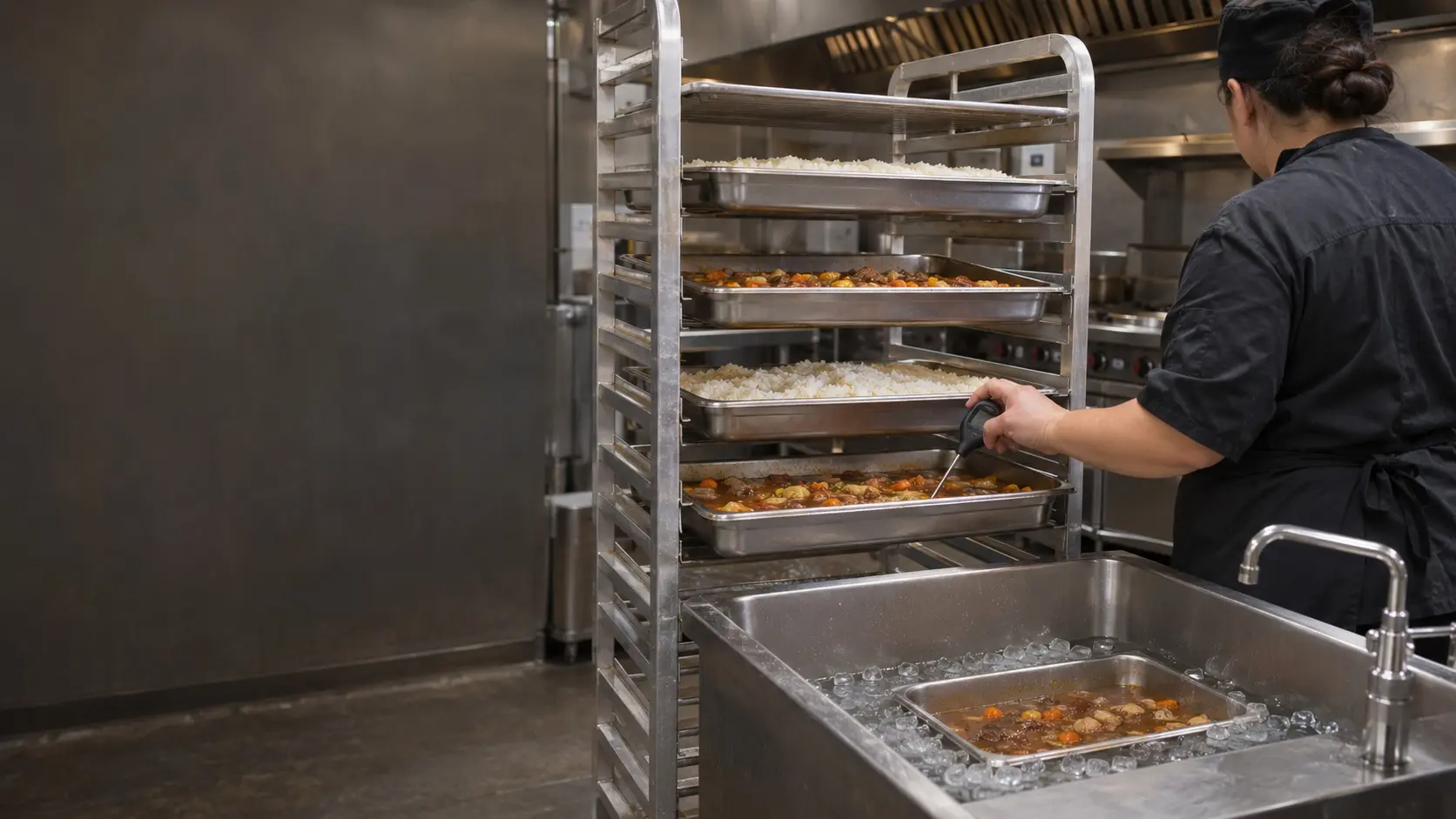
The Food Code lists the methods (section 3-501.15): shallow pans, smaller or thinner portions, rapid cooling equipment, stirring in an ice water bath, containers that move heat well, ice as an ingredient, or another method that works. All of them increase the surface of the food or add something colder than the room, and they work best combined. Putting a full stockpot into the walk-in and closing the door is not on the list.
- Shallow pans: food spread in a thin layer in a metal pan, uncovered or loosely covered until it is cold, as the Code asks. Many local health departments set a maximum depth, so use theirs.
- Ice bath: the pan or pot set in a sink or tub of ice and water, with the food stirred so heat moves out of the middle.
- Ice wand or paddle: a sealed, frozen plastic stick used to stir the food directly.
- Ice as an ingredient: part of the water in a recipe is added as ice after cooking, which lowers the temperature of a soup or sauce.
- Blast chiller: a cabinet that moves very cold air across shallow pans, built for this one task.
Divide a big batch into smaller portions before cooling. Four shallow pans cool far faster than one deep one, and the difference is often the difference between passing and failing the two-hour mark. Stir thick products, such as chili or rice, so the middle does not insulate itself.
Source: FDA Food Code 2022 — section 3-501.15 lists the cooling methods, and Annex 5 gives the reheat-or-discard guidance for a missed limit

Why can't a loaded walk-in cool hot food on its own?
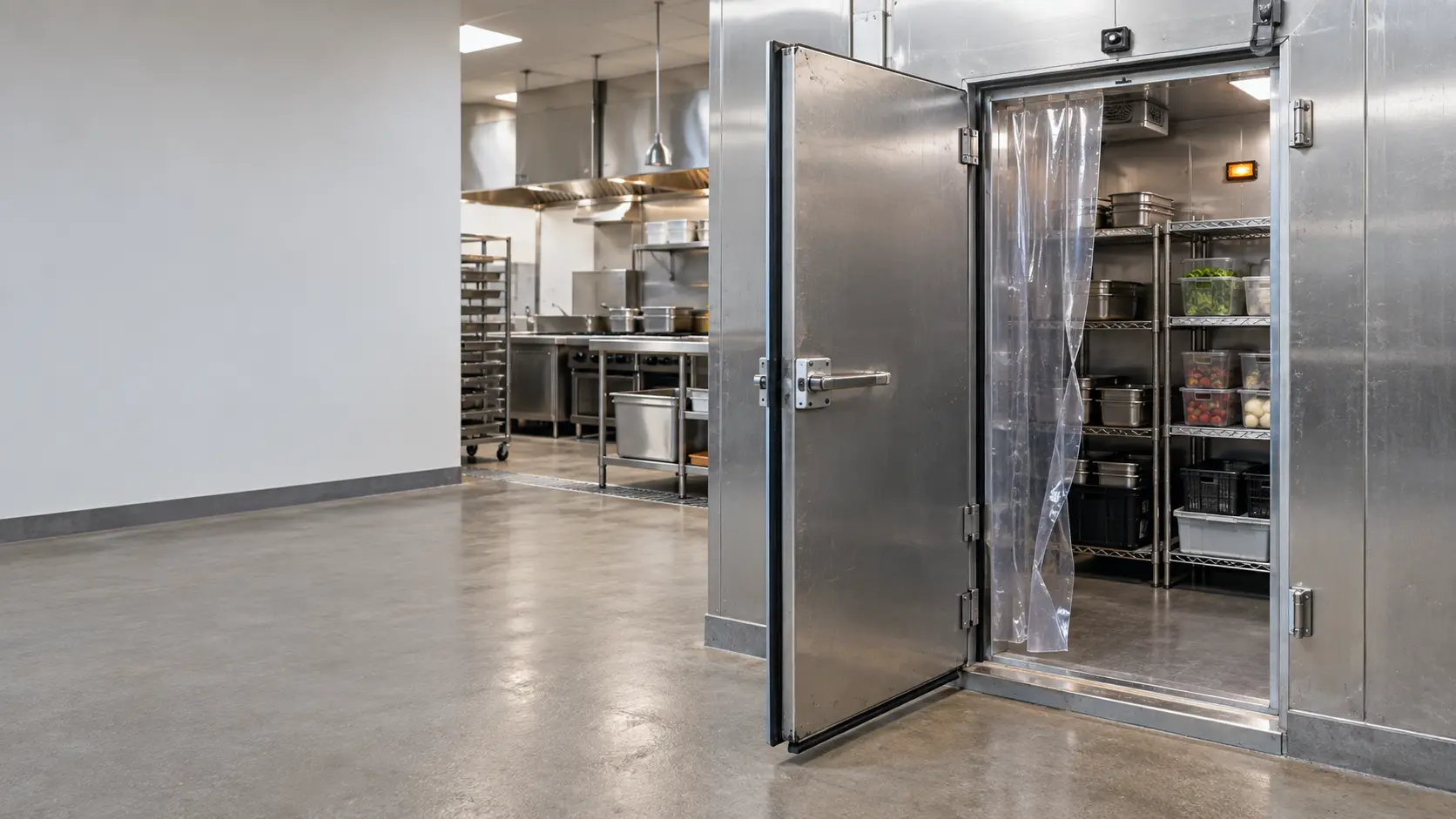
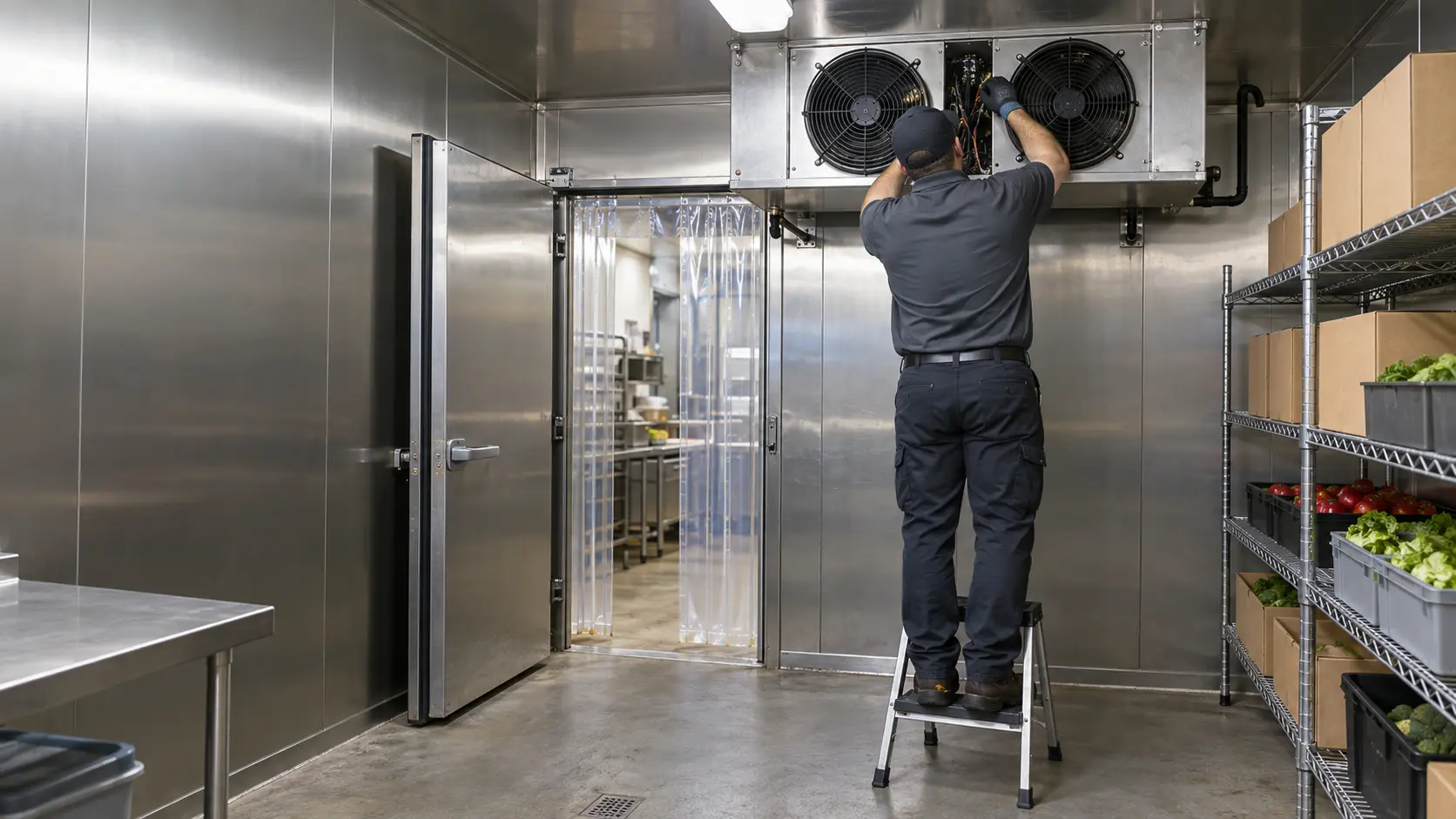
A walk-in is designed to hold food that is already cold, not to remove a large amount of heat quickly; the Food Code's own notes say commercial refrigeration is built to hold cold food, not cool large masses. Hot pans push the box beyond what its condensing unit can handle. The result is a warm walk-in and slow cooling at the same time.
What happens inside the box
Hot pans release steam and heat into the air, the box warms, and the evaporator coil frosts over from the extra moisture. The air then moves slower across the product and the cooling takes longer. Pans stacked tight or covered with tight lids trap their own heat.
What to do instead
Cool in the first stage on the counter, in an ice bath or in a blast chiller, then move to the walk-in once the food is near 70°F. Put pans on open racks with space around them, leave the lid off until cold, and keep hot product away from the raw food and ready-to-eat items on the shelves. If a walk-in struggles after a night of batch cooking, see when the walk-in runs warm for what to look at, including an iced coil and a condensing unit short of air.
How should a cooling batch be logged?
Log the start time, the temperature at the start and the temperature at each checkpoint, so that anyone can see that both limits were met. A short record also shows an inspector that the process is controlled, and it tells you quickly when a method is not working.
- Write the batch name, the time cooking ended and the starting temperature, which should be 135°F or above.
- Probe the center of the thickest pan at the 2-hour mark and write down the reading; it must be 70°F or below.
- Probe again before the 6-hour mark, counted from the start time, and write down the reading; it must be 41°F or below.
- Sign or initial the log, and note what was done if a limit was missed.
Use a calibrated probe thermometer, cleaned between pans. The same log habit works for walk-in and reach-in readings, and a series of high readings is useful to show a technician booking walk-in cooler repair.
What do staff do when a batch misses a limit?
A batch that missed the 2-hour or 6-hour mark is discarded under the FDA's inspection guidance, and a batch that is falling behind but still inside its window may be reheated to 165°F and cooled again by a faster method. The person in charge decides at once, under the health department's rules. Do not hold it for the next shift hoping it will be fine.
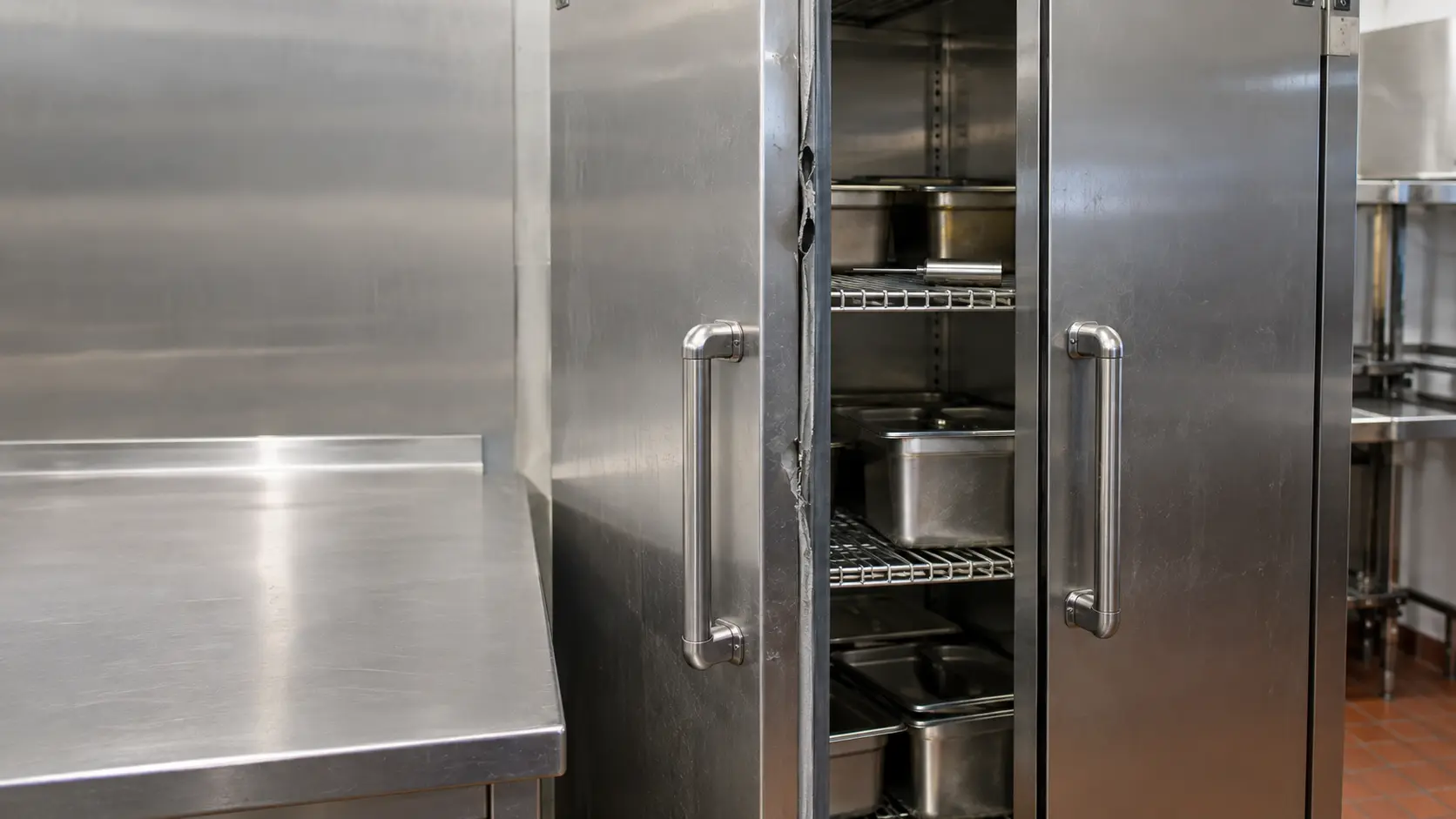
Equipment problems often hide behind a missed limit. If a reach-in drifts above 41°F whenever pans go in, or if the walk-in alarm sounds after batch cooking, the cooling method may be right and the box too weak. A reach-in and prep table repair visit can test pull-down time, door seals and the condensing unit. The guide on keeping food safe when cold storage fails explains the clock when a box is already too warm, and the problem page on a walk-in cooler running warm lists what the visit covers.
Planning for holiday batch cooking
Large batches of stock, gravy and sides in the holiday weeks add load to every box at once. Plan the day so hot pans do not all go into the walk-in at the same time, schedule the blast chiller or ice baths, and start the cleaning of coils before the rush; cleaning condenser coils on a schedule gives intervals.