What does ventless cooking equipment actually do?
Ventless cooking equipment treats its own exhaust inside the cabinet, so the air that leaves the unit has been stripped of grease and smoke instead of being carried away by a hood. The usual path is a grease filter first, then one or more further stages, such as a catalyst, an electrostatic or fine particle filter, or charcoal for odor, depending on the design, then a vent back into the room.
That arrangement is why the category exists: it moves the cost and the permitting work of a duct and a fan out of the building and into the machine. It does not remove heat or steam. A ventless oven or fryer still warms the room, and the cleaning stage is only as good as the filter in front of it.
Which equipment comes ventless
Ventless versions are sold mainly for ovens, combi ovens, some fryers and a few specialty cookers. Heavy-duty grills, open-flame ranges and griddles that smoke by design are generally not on the list. If a sales sheet offers a ventless version of a high-smoke appliance, ask which listing the claim rests on and for which menu.
Where does ventless equipment work well?
It works where the load of grease and smoke is light and the cooking is repeatable: baking, reheating, finishing, and fry baskets of a single product. Kiosks, convenience stores, coffee shops with a food case, and small tenant spaces are typical fits.
- Light menus with the same product each time, so filters load at a steady rate
- Sites where a roof penetration or a duct run is not allowed by the lease or the building
- A second cooking point added to a space that already has a hood on the main line
- Short-term or pop-up setups where a hood cannot be justified
Where it struggles
Fat-heavy, high-volume frying, breaded product with loose crumbs, and anything cooked in a way that throws grease aerosol into the unit will saturate a ventless filter faster than a schedule assumes. A kitchen that is already struggling to keep a hood clean will not find ventless equipment easier.

What do the listing and the local authority still require?
A ventless claim is only as good as the third-party listing printed on the data plate and the paperwork behind it, and the authority that signs off is local. For recirculating equipment that listing is commonly to UL 710B, the standard for recirculating systems; a plain safety listing for the oven or fryer itself is not the same thing. The same unit can be accepted in one jurisdiction and refused in the next.
Before buying, check three things in writing:
- The listing the unit carries for ventless operation, and the exact configuration it covers (one unit alone, or a stack, or with a specific filter set)
- The limits in the manual: menu type, number of baskets or pans, room clearances, maximum ambient temperature
- What the fire marshal and the health department in your area will accept, and whether the plan has to be reviewed before purchase
The data plate guide shows where the listing marks and serial number sit on most units. Retail food regulators in many places work from the FDA Food Code as a model, but each jurisdiction adopts its own version and adds its own rules, so the local office is the answer, not the brochure.
Hood rules do not disappear
A ventless unit removes grease and smoke, not heat or moisture, and the local mechanical code may still call for a hood for heat and vapor over some equipment, such as a large oven or a steamer. Where the fire code follows NFPA 96, the standard many jurisdictions use for commercial kitchen exhaust, it has its own section on recirculating systems, with items such as filter interlocks and fire suppression for grease-producing units. Which edition applies, and how it is read, is the fire marshal's call, not the seller's.
Source: FDA Food Code — confirms the Food Code is a model that state and local regulators adopt in their own versions
What upkeep does ventless equipment add?
Filters become the maintenance item that decides whether the unit works. A hood is cleaned on a schedule by someone else; a ventless unit is cleaned by your own staff, on every shift pattern the manual describes.
| Item | What to do | How often |
|---|---|---|
| Grease filter or cassette | Remove, wash or replace per the manual | As the manual states, sooner on fry-heavy days |
| Catalytic or cleaning stage | Inspect, replace when the unit's indicator or the manual calls for it | At the manual's interval |
| Cabinet and fan inlet | Wipe grease film, clear debris | As the manual states, more often on busy days |
| Door and gasket | Check seal, no grease bypass | At each filter change |
A log on the wall helps more than memory. If a filter is skipped, the unit does not stop: it starts to smoke, smells of burnt oil, and puts grease on the wall behind it. That is both a cleanliness problem and a fire risk, and the fryer fire and hood system guide explains why grease buildup is what burns.
What to ask a repair service about
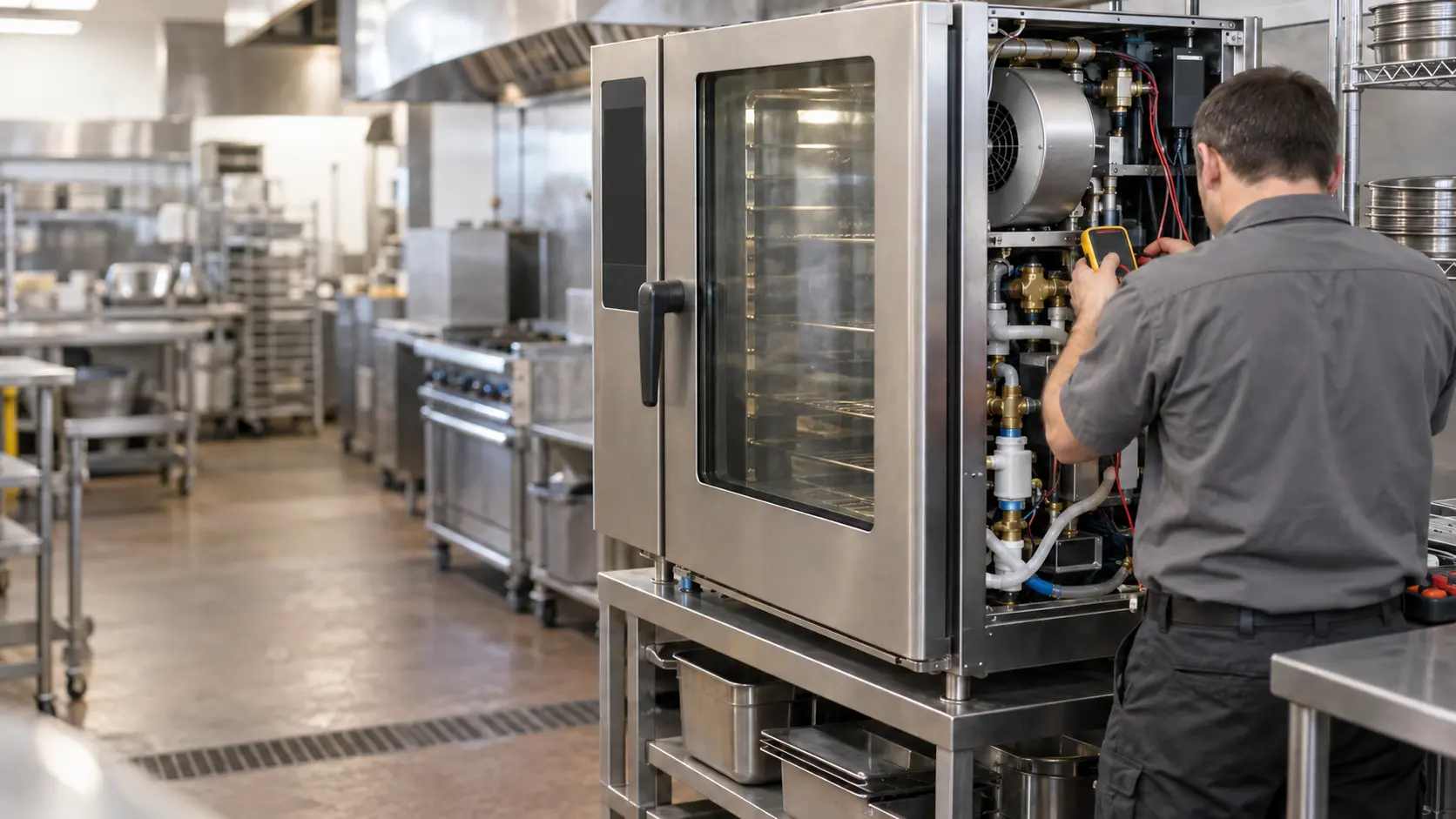
Ventless units have fans, sensors and a heated cleaning stage that a plain oven does not. A commercial oven and combi repair visit can check heating elements, fan, and controls, and a commercial fryer repair visit covers the thermostat and high-limit side of a ventless fryer. A preventive maintenance plan is the way to get the filter and sensor checks done on dates rather than after a problem.
Ventless, hooded, or a different oven?
Pick on menu and site, not on the absence of a duct. If the menu could change to something greasier within the equipment's life, a ventless unit boxed in by its listing becomes a limit. If the space cannot take a hood at all, ventless equipment is often the only route, and the menu should be written around what the unit can legally and physically handle.
| Situation | Leans toward |
|---|---|
| Light baking or reheating, no hood possible | Ventless oven |
| Single-product frying, small volume, hood refused | Ventless fryer, if listed for it |
| Steam and roasting, flexible menu | Combi, see the combi or convection guide |
| Heavy frying, grilling, open flame | Hooded line |
Fuel matters too. Ventless units are generally electric, because a gas burner's combustion products need venting whatever happens to the grease; the gas vs electric fryer guide covers the fry side. Combi owners who want to know what scale does to a steam unit can read deliming steamers and combis, which applies to ventless combis as well.
For the wider set of equipment this site covers, see commercial cooking equipment repair.